

Final week, the RBA hiked rates of interest for the fifth time this yr claiming that there have been extra demand pressures within the financial system and that unemployment needed to rise additional to carry demand again into line with provide. They speak concerning the info they get from their so-called ‘liaison’ teams however don’t disclose additional details about these ‘conferences’. The very fact is they’re speaking to foyer teams from enterprise and the monetary markets who variously need charge hikes as a result of the rising unemployment suppresses wage calls for and increase financial institution revenue margins. So in fact they’ll inform the RBA something that’s required to elicit the coverage change of their favour. The proof doesn’t assist the declare that there’s extra demand on the coronary heart of the inflationary pressures. Certainly, the proof helps two conclusions: (a) the rising oil costs is an amazing trigger and is invariant to home rate of interest adjustments; and (b) the revenue increase that the rising rates of interest is offering for wealth holders is boosting some expenditure classes (eating places, abroad journey and so forth) throughout the CPI, which can additional push the CPI up as rates of interest rise. It’s superb the established journalists by no means actually demand solutions from the RBA on these factors.
The RBA’s justification
Within the media launch (November 3, 2026) – Assertion by the Financial Coverage Board: Financial Coverage Determination – the official line was that the inflation was “elevated” and “broadly primarily based”.
They mentioned that:
This partly displays increased gas and different commodity costs affected by the battle within the Center East. However home capability pressures are additionally judged to have been slightly tighter than earlier thought …
Capability pressures seem slightly tighter than beforehand estimated and there are indications that increased gas costs are being handed by means of to costs of different items and providers. Inflation is now anticipated to stay above 3 per cent for the approaching yr and there’s an rising danger that increased inflation expectations will turn into embedded.
6 out of 9 members on the MPB voted to extend the coverage goal rate of interest, which situations mortgage charges and different longer-term company charges.
Terribly, the RBA concluded saying:
The Board will proceed to do what it considers essential to carry inflation sustainably again to focus on. Accordingly, the Board might be attentive to the info and the evolving evaluation of the outlook and dangers to information its selections. Financial coverage is effectively positioned to reply to developments, and the Board is targeted on its mandate to ship value stability and full employment.
Do no matter is “essential” within the logic of the RBA shouldn’t be in step with its twin legislative accountability to “ship value stability and full employment”.
Listed here are some info:
- The labour power information for September 2026 exhibits the unemployment charge had risen from 4 per cent to 4.7 per cent and the broad labour underutilisation charge (the sum of the unemployment and underemployment charges) has risen to 11 per cent.
- Since February 2026 when the RBA elevated the speed from 3.6 to three.85 per cent, unemployment has risen by 106.6 thousand individuals or 17.1 per cent.
- The rise in unemployment is overwhelmingly being pushed by staff who need full-time work (96.7 thousand out of 106.6 thousand.
They’re thus intentionally attempting to push extra folks into unemployment which makes a mockery of the RBA claims that it’s specializing in full employment.
The way in which establishments just like the RBA get round this inconsistency is to redefine what they outline as full employment.
The forwards and backwards lately by RBA officers, together with the governor, on what constitutes the Non-Accelerating-Inflation-Fee-of-Unemployment (the dreaded NAIRU) is testomony to this chicanery.
The NAIRU is unobservable and needs to be estimated.
The econometric estimates are very inaccurate (large normal errors) and make the purpose estimate ineffective for coverage making.
However the ideologues within the RBA simply ignore these points as a result of making claims concerning the level estimate as in the event that they know, roughly, what it’s, is extra handy for his or her agenda.
The relevance right here is that if official unemployment charge is above the estimated NAIRU, then the New Keynesians declare that the inflation charge will fall.
Conversely, if official unemployment charge is under the estimated NAIRU, then the New Keynesians declare that the inflation charge will rise.
And, importantly, the causality that’s developed within the theoretical fashions is from unemployment charge to inflation by way of demand (spending) pressures.
So, if the unemployment charge is under the NAIRU, these economists conclude that there’s an excessive amount of demand strain within the financial system and value stability requires that coverage tighten whole spending by pushing up the unemployment charge.
The issue although is that the RBA (and economists who peddle this theoretical nonsense) preserve revising the NAIRU estimate up after they discover the estimates don’t match the speculation.
We noticed that within the inflationary episode publish COVID restrictions.
The Governor of the RBA has admitted many occasions that the RBA makes use of the NAIRU to find out whether or not there’s full employment or not and that presently (throughout the COVID inflation):
… employment is above what we’d take into account to be in step with our inflation goal.
And so if companies have market energy and use it to push increased mark-ups to gouge extra income, then the RBA would attempt to cease that inflationary strain by pushing up unemployment.
The unemployment that lastly stopped the revenue push could be very excessive but the RBA would name that full employment despite the fact that hundreds of thousands of staff could be with out work.
For a dialogue of all this please discuss with the weblog publish – Mainstream logic ought to conclude the Australian unemployment charge is above the NAIRU not under it because the RBA claims (July 24, 2023).
On June 20, 2023, the Governor (then Deputy Governor) of the RBA was in Newcastle for a enterprise occasion and her speech was entitled – Attaining Full Employment
Within the Q&A, the Governor mentioned that to stabilise inflation:
… the unemployment charge must rise … the NAIRU … 4½ in all probability appears to be like, we expect, possibly within the ballpark.
Within the Speech-proper, she mentioned:
The unemployment charge is anticipated to rise to 4½ per cent by late 2024 … Whereas 4½ per cent is increased than the present charge, this end result would nonetheless go away us under the place it was pre-pandemic and never far off some estimates of the place the NAIRU may presently be. In different phrases, the financial system could be nearer to a sustainable steadiness level.
On the time, the official unemployment charge was round 3.5 per cent.
A while later, with the unemployment charge nonetheless under 4 per cent, the RBA appeared to change its place and mentioned the NAIRU was round 4.25 per cent.
Now the unemployment charge is 4.7 per cent and the RBA claims it has to rise additional.
They can not get a straight line on this and that’s as a result of there isn’t any constant line that may be taken.
The NAIRU idea could be very fuzzy and estimates derived from econometric modelling are all over, such that the estimates actually can’t be used to information coverage.
What we noticed in 2022 and past was that the unemployment charge in Australia was extremely steady at round 3.6 per cent within the aftermath of the pandemic regardless of the inflation charge rising from under 3 per cent to its December 2022 peak above 8 per cent.
The RBA claimed the inflation was as a result of the unemployment charge was under the NAIRU estimate (the idea is unobservable in fact).
So off they went climbing charges however for the following yr, inflation fell dramatically again to only over 3 per cent as the availability constraints arising from the pandemic eased.
That was all the time going to occur.
However the different factor we noticed was that because the inflation peaked after which quickly declined, the unemployment charge remained steady round 3.5 to three.7 per cent (effectively under 4.5 per cent and even 4.25 per cent).
If the RBA’s evaluation of the NAIRU stage was appropriate, then inflation ought to have been accelerating, given the official unemployment charge was under the RBA’s NAIRU estimate.
However given the fact of a comparatively steady unemployment charge and falling inflation, then the logical conclusion would have been that the official unemployment charge will need to have been above the NAIRU if that idea was relevant.
The RBA by no means responded to that criticism.
What concerning the RBA declare that the financial system is overheating in capability phrases?
I’ve already famous that broad labour underutilisation is over 11 per cent now.
That’s, round 11 per cent of the keen and out there labour assets should not working in a technique or one other – both by no means (unemployment) or much less hours than desired (underemployment).
What doable conception of full capability may one have to say that 11 per cent of labour assets not working who need to work constitutes full employment.
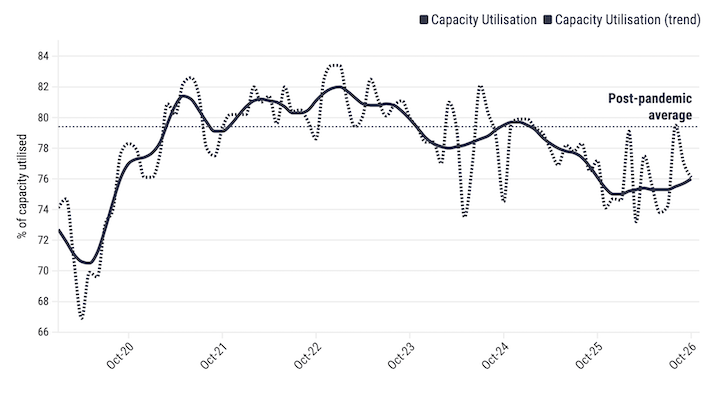
Additional, the Australian Business Group compiles a – Capability utilisation – (as one of many exercise indicators as a part of its Australian Business Index outputs).
The next graph is taken from that sequence (the strong line is the pattern).
It is not uncommon for companies to take care of some extra capability, which is designed to permit them to fulfill sudden will increase in orders.
Nevertheless, because the graph exhibits over the interval since 2022, capability utilisation throughout the financial system has considerably declined and is now at 76.1 per cent.
That implies that there 27.2 per cent of the out there productive capability shouldn’t be being utilised.
Traditionally that’s a variety of extra capability.
The survey additionally notes that:
Value pressures elevated additional because the preliminary affect of upper gas costs is now passing alongside provide chains. Weak market situations imply business is unable to totally cross these prices on, inserting mounting strain on margins.
So if there’s broadening of value pressures occurring it’s as a result of the imported gas costs stay at elevated ranges.
The query is: How does the worldwide value of oil reply to rising home rates of interest?
The reply: By no means!
The CPI driving forces
When there are inflationary pressures the smart coverage evaluation is to work out what’s inflicting them.
The one-size-fits-all New Keynesian financial coverage that central banks comply with (largely) nowadays largely ignores that time and treats the inflation as a capability overshoot which requires the demand aspect regulate downwards to produce.
Nevertheless, if the present scenario has little to do with extreme spending and all to do with supply-side causes then rising rates of interest is the very last thing {that a} smart coverage regime would ponder.
The availability-side inflation is already hurting low revenue households.
Then the RBA thinks it’s acceptable to inflict extra ache by making their mortgages costlier, whereas on the identical time lining the pockets of the top-end-of-town who’re having fun with booming incomes because of their monetary belongings delivering increased curiosity.
And the business financial institution shareholders are laughing as a result of their banks are booming because of the RBA paying increased curiosity on the surplus reserves held within the system.
The business banks would not have to do something in any respect they usually nonetheless revenue handsomely because of these (pointless) transfers from the RBA.
The RBA ought to simply abandon curiosity funds on extra reserves.
However the overwhelming drawback is that the rate of interest hikes should not in a position to goal the most important causes of the inflationary pressures.
The next graph exhibits the proportion of the whole change within the CPI accounted for by the most important CPI elements.
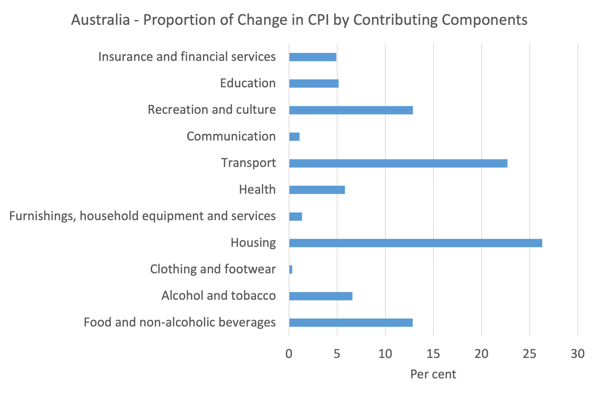
The All teams CPI rose by 4.3 per cent within the 12 months to September 2026.
4 of 11 classes that contribute to that mixture end result had been stronger contributors than the others.
- Meals and non-alcoholic drinks contributed 0.558 factors to the whole change (round 12.85 per cent).
- Transport contributed 1.142 factors to the whole change (round 26.30 per cent).
- Housing contributed 0.985 factors to the whole change (round 22.70 per cent).
- Recreation and tradition contributed 0.559 factors to the whole change (round 12.88 per cent).
If we dig deeper we see that:
- Underneath the Transport element, 78.2 per cent of its affect on the CPI in September got here from automotive gas.
- Underneath the Housing element, 21 per cent got here from rents and 35.3 per cent got here from Utilities (largely electrical energy). The RBA is pushing the hire CPI element up by driving charges up – landlords dealing with increased mortgage servicing on their funding properties are then passing the prices onto tenants in a decent rental market. The electrical energy costs are rising as a result of the privatised sector is gouging shoppers beneath the regulated value framework.
- Underneath Meals and non-alcoholic drinks element, 49.6 per cent is meals out and take away meals, largely restaurant meals. I surmise {that a} important proportion of that spending is coming from the upper revenue people who’re benefiting from the revenue results of the upper rates of interest on their monetary wealth.
- Underneath the Recreation and tradition element, 45 per cent of the affect is journey – once more I think pushed by increased revenue people.
The purpose is that this information doesn’t point out an financial system that’s working above full capability.
There may be appreciable capital and labour wastage within the system.
Additional, the primary drivers of the inflation are both:
1. Linked to the oil difficulty and invariant to home rate of interest actions; or
2. Boosted by rate of interest hikes (rents, enterprise prices, top-end-of-town revenue results).
As a consequence, the rising rates of interest will:
1. Not scale back inflation.
2. Damage low revenue households and redistribute huge quantities of revenue from the poorer residents who’ve mortgages to the richer residents who maintain monetary belongings.
3. Finally trigger a recession and drive tens of hundreds extra out of labor, additional compounding the harm.
Conclusion
It’s superb that the mainstream media should not pushing these points and demanding solutions from the RBA officers.
A lot of the commentary appears to come back from journalists who consider themselves as ‘insiders’.
They clarify the RBA logic – that’s repeat the dogma – as a result of they get invited to briefings and so forth and that makes them really feel necessary.
That’s sufficient for at the moment!
(c) Copyright 2026 William Mitchell. All Rights Reserved.

