



The beginning of the Center East battle in early 2026 induced an unprecedented drop in world petroleum provide. In response, oil costs jumped—however to not unprecedentedly excessive ranges. The U.S. oil sector was a key consider moderating the shock. For one, its regular will increase in drilling helped create a big oversupply within the world market earlier than the battle, making it much less of a problem to offset the drop in Center East oil output. As well as, U.S. business and authorities inventories have been quickly drawn down, filling half the hole between world provide and demand within the second quarter by some estimates. Inventories, although, are a restricted useful resource and U.S. stockpiles stopped falling in July. As a consequence, the continued shortfall in world manufacturing has been managed by operating down inventories in the remainder of the world.
The Transformation of the U.S. Oil Sector
The U.S. financial system has a historical past of being weak to geopolitical developments. Home drilling stopped rising in 1970, that means that will increase in consumption needed to be glad by imports, which doubled from 1970 to 1973. Most of this new provide was from OPEC and the 1973 disaster illustrated how home gasoline costs might rise dramatically due to international developments. This level was strengthened by one other worth shock in 1979.
This vulnerability led to the creation of the Strategic Petroleum Reserve (SPR), a authorities stockpile to be launched when oil provides have been threatened, however little else may very well be performed concerning the underlying development. Within the years that adopted, the rise in oil demand, coupled with stagnant drilling, induced imports to exceed exports by 9 million barrels per day (mb/d) in 2010, or virtually half of home consumption.
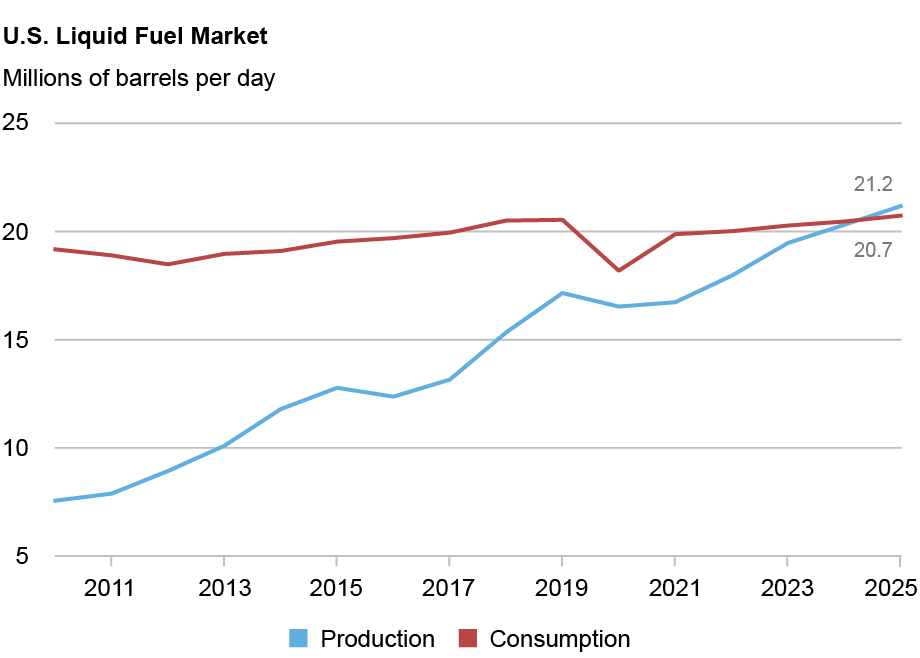
The state of affairs modified with the adoption of fracking know-how. As seen within the chart under, U.S. output of crude oil and different liquid fuels jumped from 8 mb/d in 2010 to 21 mb/d in 2025. To place the rise in perspective, world manufacturing rose by 19 mb/d over this era, that means america accounted for 70 % of that achieve.
U.S. Manufacturing Has Elevated Dramatically
A key improvement behind the sustained manufacturing surge was the 2015 repeal of a 1975 legislation that had largely prohibited exports of crude oil. (Exports of refined merchandise weren’t restricted.) The business efficiently argued that the potential output from the Permian Basin in New Mexico and Texas was greater than the Gulf area’s refineries might accommodate. Its really useful resolution to this bottleneck was to allow promoting into international markets. Shoppers would profit, even when the added oil was exported, because the enhance to world manufacturing would feed again into decrease home costs.
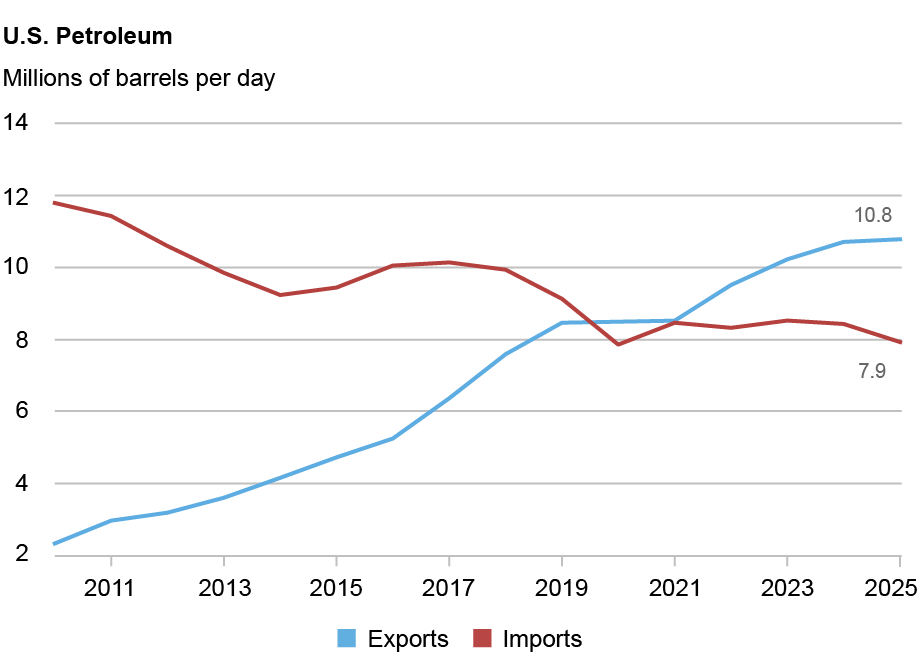
The chart under exhibits how the 2015 repeal affected commerce flows. From 2010 to 2015, the rise in drilling diminished imports of crude liquids and refined merchandise and elevated exports by roughly equal quantities (2 mb/d). However with the tip of restrictions on crude oil gross sales, petroleum exports elevated by a further 6 mb/d from 2015 to 2025, whereas imports fell by 2 mb/d.
U.S. Petroleum Exports Now Exceed Imports
A Sudden Scarcity After Being Oversupplied
The battle with Iran severely disrupted the petroleum market. The chart under exhibits the U.S. Vitality Info Administration’s (EIA) estimate of world manufacturing of liquid fuels and world consumption. The change in stock ranges is the hole between the manufacturing (provide) and consumption (demand) strains primarily based available on the market clearing equation:
Provide + Change in Inventories = Demand
For instance, the final remark for September places manufacturing at 101 mb/d and demand at 104 mb/d, implying stock ranges declined at a fee of three mb/d within the month.
Inventories Had been Rising Earlier than Hostilities Began

Provide moved considerably above demand over the course of 2025, as larger output in america, Brazil, and others elevated manufacturing whereas demand rose extra slowly. Consequently, inventories went from being unchanged in 2024 to rising at a 2 mb/d common fee in 2025 and at a 4 mb/d fee within the first two months of 2026. World manufacturing collapsed by 12 mb/d in March, so having this oversupply considerably diminished the quantity of the shortfall that needed to be made up.
The hole between provide and demand induced inventories to fall at a fee of 5 mb/d in March. Comparable drawdowns occurred in April and Could earlier than output recovered in June when tensions eased, leaving inventories shrinking at a 3.5 mb/d fee within the second quarter. Inventories stabilized in July, however the resumption of tensions induced stock ranges to fall at a 3 mb/d fee in August and September.
Operating Down the Buffer
How did the U.S. oil sector assist bridge the availability shortfall? The choices have been both to extend manufacturing or to attract down inventories. There was not a lot that may very well be performed instantly on the manufacturing aspect because the business doesn’t function with spare capability. Drilling is rising however at a fee just like charges achieved in recent times, with the EIA forecasting U.S output rising by 0.7 mb/d in 2026 versus 0.9 mb/d in 2024 and 2025.
That left home inventories. Their stage was unchanged in March however then fell within the subsequent three months, with the SPR releasing crude oil on the fee of 1 mb/d within the second quarter and business inventories falling at a 0.7 mb/d fee. Collectively this drawdown accounted for roughly half of the estimated drop in world stock ranges.
The decline in inventories, together with modest adjustments in drilling and consumption, translated into extra oil obtainable for the remainder of the world. By way of commerce flows, web exports elevated by 2.5 mb/d within the second quarter, with exports up 2 mb/d and imports down by 0.5 mb/d.
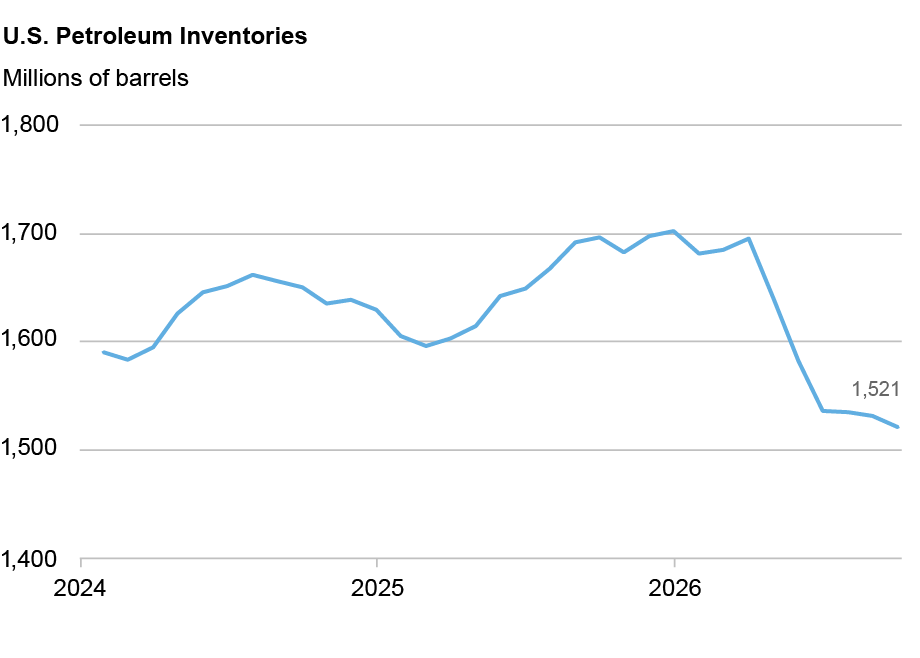
U.S. inventories stopped falling in July, as seen within the chart under, and remained comparatively flat by September. The top of the drawdown induced the online exports stability within the third quarter to fall again to close its first quarter stage.
Stock Ranges Stopped Falling in July
The implication is that the continuing depletion of world inventories is being left to different international locations. Most notably, China, the world’s second largest shopper of petroleum, has made extreme cuts to its imports since April, suggesting a considerable fee at which its oil shares have been run down.
Trying Ahead
It’s not clear how the Center East battle might be resolved. Think about two outcomes. In a single, the battle ends and output from the Center East international locations returns to pre-conflict ranges. Costs then face downward strain because the market heads again to being oversupplied, with the caveat that costs might not shortly return to pre-conflict ranges because the world rebuilds its stockpiles. One other chance is that Center East output stays considerably under its earlier stage inflicting the hole between world provide and demand to persist. Sooner or later, world stock ranges get too low and demand should fall to match provide.
The U.S. oil sector is doing its half to reasonable worth pressures by boosting home oil output. On the demand aspect, progress in electrifying transportation is reducing world oil consumption from what it could be in any other case. Certainly, one results of the turmoil is that it encourages quicker electrification, bringing ahead the yr when world oil demand begins to say no.

Thomas Klitgaard is an financial coverage advisor within the Federal Reserve Financial institution of New York’s Analysis and Statistics Group.
Methods to cite this submit:
Thomas Klitgaard, “The U.S. Oil Sector’s Function in Restraining Costs,” Federal Reserve Financial institution of New York Liberty Road Economics, November 5, 2026, https://doi.org/10.59576/lse.20261105
BibTeX: View |
Disclaimer
The views expressed on this submit are these of the creator(s) and don’t essentially replicate the place of the Federal Reserve Financial institution of New York or the Federal Reserve System. Any errors or omissions are the accountability of the creator(s).

