

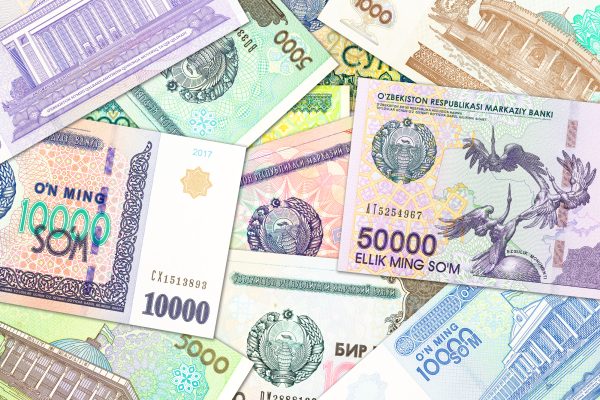
On October 23, the Central Financial institution of Uzbekistan (CBU) issued its first license granting official permission to offer Islamic banking providers to Open Financial institution Joint-Inventory Firm, marking a brand new web page within the nation’s try to develop monetary inclusion.
Uzbekistan has been attempting to develop entry to monetary providers and produce more cash into the formal banking system for years. In 2019, Uzbekistan grew to become a member of the Worldwide Islamic Commerce and Finance Company and the Funding and Export Credit score Insurance coverage Islamic Company.
President Shavkat Mirziyoyev, in his 2020 deal with to the parliament, highlighted the necessity to introduce Islamic financing. “The time has come to create a authorized framework for the introduction of Islamic monetary providers in our nation,” Mirziyoyev stated. “Consultants from the Islamic Growth Financial institution and different worldwide monetary organizations shall be concerned on this regard.”
In a 2023 pre-election assembly with potential voters in Namangan, one of the vital populated areas of Uzbekistan traditionally following a stricter type of Islam, Mirziyoyev even promised to have Islamic financing system working in Namangan.
Though Uzbekistan allowed microfinance organizations to offer Islamic financing from 2022, the CBU solely permitted laws governing such providers in 2024. That yr, the CBU joined the Islamic Monetary Providers Board (IFSB). In 2025, Tashkent hosted the twentieth Worldwide Shariah Students Discussion board in Islamic Finance (ISSF) – the primary time the occasion was held outdoors Malaysia.
Additionally in 2024, the Legislative Chamber of the Oliy Majlis adopted a draft regulation on introducing Islamic banking actions.
In 2026, progress accelerated. In March, Mirziyoyev signed a regulation that established the authorized framework for organizing Islamic banking, together with establishing licensing, regulating, and taxing necessities. By mid-July, the CBU established a Islamic Finance Council of 5 individuals, together with members from the Muslim Board of Uzbekistan.
Whereas Tashkent’s ambitions are clear, the financial case rests on two expectations: that folks use Islamic financing and savers will place their financial savings in Islamic funding accounts.
Uzbekistan is a Muslim-majority nation with a complete inhabitants exceeding 39 million. The precise variety of Muslims is tough to gauge – whereas each the U.S. Division of State and Human Rights Watch estimate that over 80 p.c of the inhabitants observe Islam, the Committee on Non secular Affairs of Uzbekistan reported that determine to be 94 p.c as of 2015. Neither, nonetheless, estimates what number of Uzbek residents would favor Islamic financing, no matter their religion.
In 2023, Bakhrom Nomonov, then chairman of the board of Apex Financial institution, famous that 20 p.c of Uzbek residents don’t take out conventional loans from banks resulting from their spiritual beliefs. Subsequently, he argued, Islamic financing may entice as much as $10 billion a yr to the nation. A 2020 survey performed throughout the framework of the United Nations Growth Program on “Evaluation of Islamic monetary merchandise in Uzbekistan” additionally indicated spiritual beliefs as one of many essential causes many Uzbek individuals to not take out conventional financial institution loans.
The Muslim Board of Uzbekistan, in addition to common imams, all interpret riba – taking an interest-based mortgage from a financial institution (domestically generally known as taking a credit score) – as a sinful act, whereas different types of Islamic financing – resembling leasing, and murabaha –are deemed permissible.
This, nonetheless, doesn’t imply a nationwide strict commentary of Islam, together with in finance. Many Uzbeks contemplate Islam part of their tradition. It’s one thing that they’re born into and many individuals merely don’t observe each single fatwa or suggestion from an imam. (Uzbekistan is a secular state and the fatwas issued by imams will not be binding by regulation.) The existence of some strict observers is matched by these with extra lax approaches. The most recent report from the Central Financial institution reveals that as of 2025, 20 p.c of adults within the nation have an lively financial institution credit score account with virtually one-third of them having taken 1.7 loans on common.
Whether or not Uzbek residents take out financial institution loans or put their financial savings into funding accounts is just not completely – and even predominantly – a non secular query. The provision of halal loans would possibly create extra probabilities, but when Islamic financing prices greater than typical financial institution loans – when a brand new product is launched, it normally competes with different comparable merchandise available in the market – there is no such thing as a assure that the Muslims of Uzbekistan will select a dearer halal one.
One other impediment lies with popularity. Inclusion of members from the Muslim Board of Uzbekistan into the CBU’s Islamic Finance Council will enhance its credibility among the many public as nearly all of Muslims in Uzbekistan belief official spiritual endorsements. Nevertheless, this additionally raises the query of who checks these techniques for compliance and conducts audits. IMAN make investments, an organization that provides Islamic funding merchandise, is at the moment embroiled in an enormous scandal. The Islamic Finance Consulting Board (IFCB) terminated its cooperation with the corporate, with board member Mahmud Usmon alleging misuse of investor funds in violation of Islamic finance ideas and a deficit of $20 million in its funding portfolio. The corporate has disputed the allegation and is attempting to revive public belief.
This one dispute doesn’t imply that licensed Islamic banks will face the identical difficulties or allegations, however the dangers stay. It simply takes one revered scholar questioning a product’s Islamic compliance to undermine public belief, and with out public belief even the religious would possibly draw back from Islamic financing choices.
Reportedly, greater than 10 business banks in Uzbekistan are making ready to introduce Islamic finance merchandise. Their success with beforehand underserved populations is to be seen within the coming years and is topic to competing providers and credibility. The variety of licenses is an preliminary indicator of curiosity, not a assure of success.
This analysis was supported by a Marie Curie Employees Trade throughout the Horizon Europe Programme (CARSI, no: 101086415)

