

Given among the frictions and prices concerned with implementation, many refined tax planning methods have traditionally been the purview of solely the wealthiest buyers. Nonetheless, due to technological and different advances, in recent times sure tax-aware funding methods have change into out there to a wider vary of buyers. On the identical time, innovation in funding methods and merchandise can typically push the boundaries of what the IRS finds acceptable, probably exposing buyers who use them to better scrutiny.
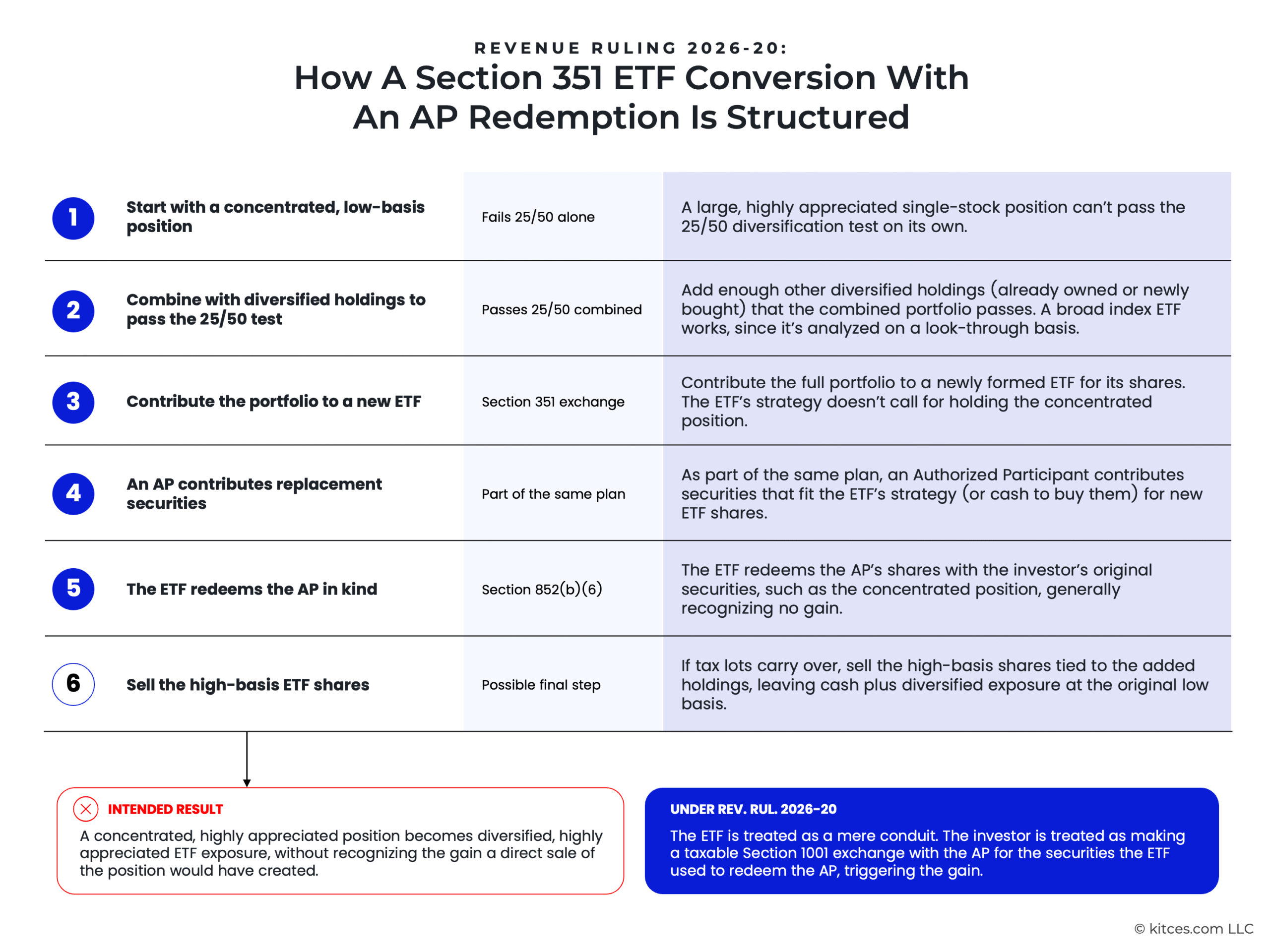
Amidst this backdrop, the IRS has issued formal steerage concerning sure tax-aware funding methods which have been rising in reputation. Its extra definitive assertion, Income Ruling 2026-20, addresses a variation of the Part 351 ETF conversion (which buyers can use to diversify concentrated positions whereas deferring capital beneficial properties) during which securities that do not match the ETF’s funding thesis are exchanged with an Licensed Participant, as a part of the identical plan, for securities that do. On this case, the IRS concluded that the ETF shouldn’t be revered as an impartial middleman, and that the investor must be handled as having made a taxable alternate. The company didn’t, nonetheless, prohibit Part 351 ETF conversions extra broadly, leaving a great deal of grey space between what’s clearly permitted and what’s not.
The IRS additionally not too long ago issued Discover 2026-62, which identifies transactions that concern the company. The Discover describes extra steerage or enforcement actions the federal government might take into account pending a public remark interval (together with steerage that would apply retroactively), making it much less definitive than the Income Ruling, although nonetheless useful to know the varieties of transactions and merchandise which can be on the IRS’ radar. Methods recognized within the discover embrace a partnership/exchange-fund variation of the Part 351 transaction, box-spread ETFs (which generate interest-like revenue that turns right into a deferred capital achieve), ETFs that defer revenue by rotating between underlying ETFs with totally different dividend document dates, ETFs that search to skirt the registered funding firm qualifying-income guidelines, and sure methods designed to use variations within the character of economically offsetting beneficial properties and losses.
With these (and different) IRS statements in thoughts, monetary advisors contemplating a selected tax-aware funding technique for a number of shoppers may first decide whether or not there would nonetheless be a reliable funding motive for the consumer to personal the technique if the projected tax profit had been materially smaller than anticipated (i.e., it has a sexy danger/return profile even within the absence of marketed tax advantages).
From there, the method appears to be like very like the one advisors already use for funding danger: estimating the web profit if the technique works (after charges, financing, {and professional} prices, and recognizing that among the ‘financial savings’ might merely be deferral), the overall value if it would not (together with curiosity, penalties, {and professional} charges), and the energy of the tax place itself (together with enter from an impartial tax skilled and whether or not any exterior authorized opinion has been up to date for the brand new steerage).
Additional, an advisor may work with a consumer to evaluate their private “tax danger tolerance” (i.e., their willingness to pursue a tax-aware funding technique which may later carry them underneath IRS scrutiny), alongside their capability for that danger (e.g., whether or not they have ample liquidity if the technique is deemed impermissible and they’re confronted with a big tax invoice and, probably, penalties). Whereas some shoppers may see the upside potential of a technique as being price a possible audit or perhaps a case in Tax Courtroom (together with the accounting and authorized charges they may face), others won’t be keen to take that danger.
Finally, the important thing level is that whereas the IRS is not ‘declaring warfare’ on tax-aware funding methods, monetary advisors and their shoppers can probably anticipate extra steerage, and extra scrutiny, on sure methods that seem to push the boundaries on permissibility. Which means that monetary advisors can help their shoppers by serving to them perceive their private tax danger tolerance – and recommending specific tax-aware funding methods (or not) accordingly!
 |
And if you wish to go deeper on this matter, hear immediately from the writer on the Monetary Advisor Technician podcast. |


