Deliberate giving is a vital a part of a strong nonprofit fundraising technique. This various class of presents can unlock progress on your group, allow you to attain new prospects, and deepen your ties with donors. But kicking off with a well-thought-out deliberate giving technique could be difficult for organizations, as this type of fundraising is not like typical campaign-based annual fundraising drives.
To get began, growth groups should first perceive the fundamentals. This fast information will cowl the necessities by answering the next key questions:
Creating a transparent deliberate giving program technique permits nonprofits to safe transformative future help, construct institutional resilience, and set up sustainable long-term funding streams. By implementing structured present insurance policies, securing board governance buy-in, and standardizing administrative workflows, organizations of any measurement can launch a scalable legacy giving initiative from scratch.
Let’s dive in!
What’s deliberate giving for nonprofits?
Deliberate giving consists of donations to nonprofits made by means of donors’ estates or monetary plans. Organizations that pursue these presents constantly accomplish that by means of devoted deliberate giving packages, which are sometimes managed as a part of or alongside their different growth efforts like main present fundraising.
Most deliberate presents are bequests established in donors’ wills and disbursed after their passing. However deliberate giving is far more than bequests. Actually, it’s a particularly various class of presents.
What are the frequent kinds of deliberate presents?
Along with bequests, deliberate giving contains donations like:
- Retirement plans and life insurance coverage: A donor names a nonprofit because the beneficiary of a life insurance coverage coverage or unused retirement property.
- Charitable present annuities: A donor provides a big donation in change for a set revenue fee. The nonprofit can make investments these funds and preserve any remaining funds when the annuity’s phrases are up, or the donor passes away.
- Charitable the rest trusts: A donor provides a present of money or securities in change for an revenue fee of a proportion of the principal quantity, which could be revalued and elevated yearly relying on the kind of belief created.
- Charitable lead trusts: A donor makes funds to the nonprofit for a sure variety of years or their lifetime. On the finish of that time period, the funds are returned to the donor or their beneficiaries.
| Major Supply Asset | Typical Donor Motivation | Operational Complexity | |
| Bequests (Wills & Trusts) | Property property, money, property | Legacy creation, ease of modification | Low |
| Beneficiary Designations | IRAs, 401(ok)s, life insurance coverage | Tax effectivity, easy execution | Low |
| Charitable Reward Annuities (CGAs) | Money, appreciated securities | Assured fastened revenue, tax deduction | Medium to Excessive |
| Charitable The rest Trusts (CRTs) | Actual property, extremely appreciated inventory | Revenue era, substantial tax mitigation | Excessive |
Every sort of deliberate present brings totally different necessities and advantages, so the present {that a} donor finally decides to make will hinge on a number of components, together with their monetary state of affairs and giving motivations. Some presents may also work greatest for under sure kinds of high-impact donors.
Many nonprofits additionally pursue a wide range of non-cash presents alongside their deliberate giving packages because the processes of figuring out these donors and establishing their presents could be pretty comparable. Widespread non-cash present choices embody:
- Grants from donor-advised funds
- Donations of actual property
- Items of personal or public inventory or mutual funds
- Items of cryptocurrency
Discover the extra sources on the finish of this text to start out studying extra about these kind of donations.
What’s the state of deliberate giving right now?
How a lot alternative is there for nonprofits in deliberate giving right now? Who creates deliberate presents? Understanding the context and developments of this sort of giving will empower your group to create the absolute best technique.
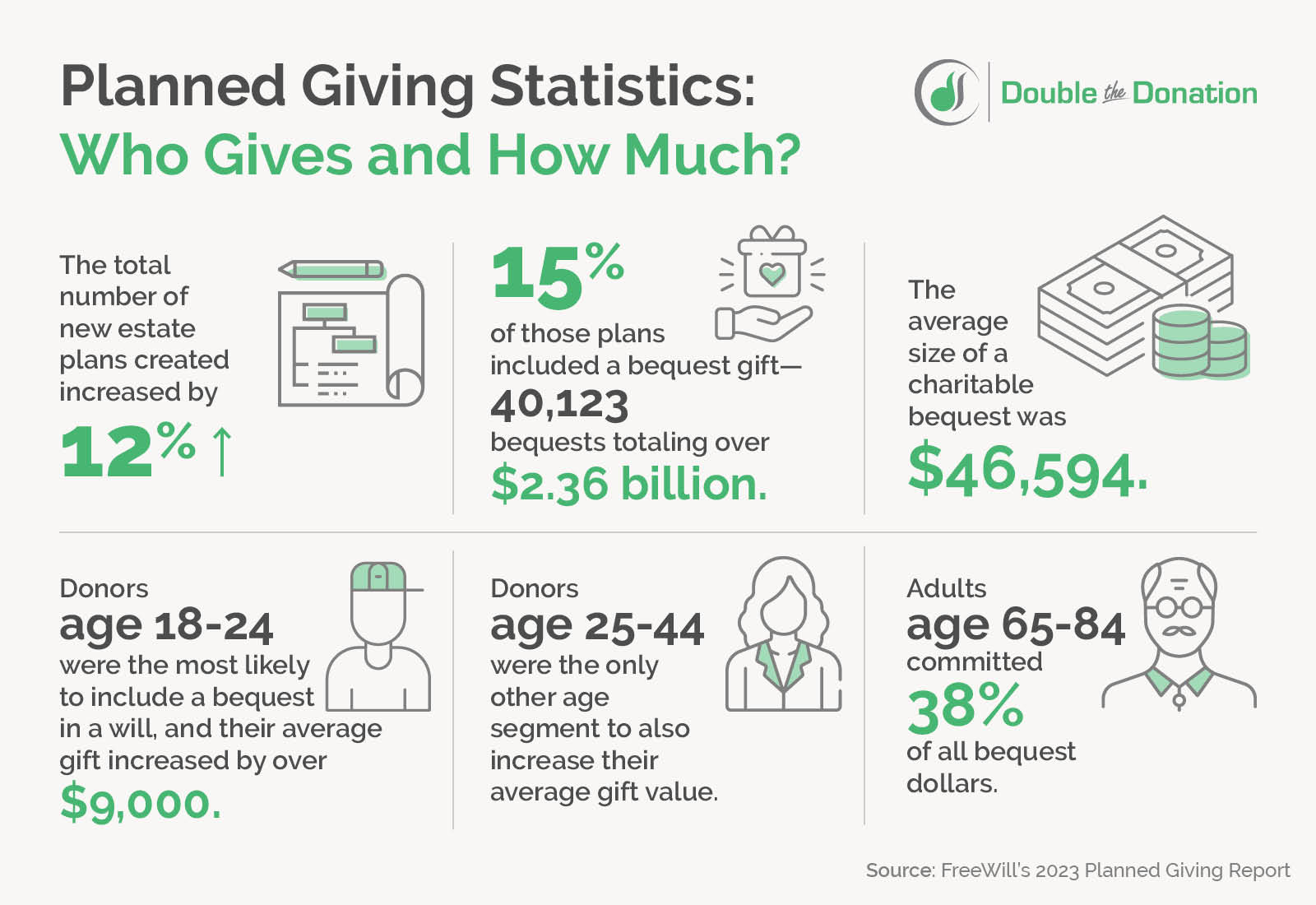
Discover just a few deliberate and legacy giving benchmarks right here to start:
- The full variety of property plans created elevated by 12% over the earlier yr.
- 15% of these customers selected to create a bequest present—a complete of 40,123 bequests including as much as a price of over $2.36 billion.
- The typical measurement of a charitable bequest was $46,594.
- Youthful will-makers are expressing an elevated curiosity in bequests. These aged 18-24 had been the almost definitely to incorporate a bequest in a will, and their common present elevated by over $9,000. These aged 25-44 had been the one different age section to additionally enhance their common present worth.
- Older will-makers nonetheless signify the biggest teams concerned in deliberate giving, with adults aged 65-84 committing 38% of all bequest {dollars}.
These developments are occurring inside the bigger phenomenon of the “Nice Wealth Switch,” an unprecedented switch of property from the growing older Child Boomer inhabitants to their heirs and charitable organizations—estimated to be round $68 trillion over the following 25 years.
Key takeaways: Donors are making wills and property plans, particularly as they age. Should you’re not asking them to think about making a deliberate present, you’re lacking out.
Contemplating the giving patterns of older donors, the Nice Wealth Switch, and youthful generations having fun with or coming into their prime working years, a strong deliberate giving technique can generate vital income on your group. You’ll simply have to know easy methods to speak about deliberate giving successfully, beginning with its advantages.
What are the advantages of deliberate giving?
Deliberate giving can assist each the donor and the nonprofit in vital methods. Let’s take a more in-depth look.
Advantages for Donors
- Deliberate presents enable donors to create lasting legacies and influence on the missions that they care about and/or have been significant for his or her households.
- These donations are additionally extremely versatile, giving donors the choice of designating particular functions for the funds and updating their directions over time.
- Deliberate presents typically additionally deliver vital tax advantages for donors, normally regarding property taxes, which is usually a main motivator for some. Nonetheless, the precise tax implications of deliberate presents can fluctuate broadly, so it’s essential to keep away from giving donors specific recommendation and as a substitute direct them to professionals to substantiate the specifics.
Advantages for Nonprofits
- Deliberate giving is inherently significant and might significantly deepen relationships between your group and its donors when thoughtfully stewarded.
- Financially talking, deliberate presents could be extraordinarily useful for nonprofits. They’re typically a lot bigger than typical money donations, and so they’re normally unrestricted. A deliberate giving program can create a predictable, reliable supply of normal funding.
- Deliberate presents are additionally extra accessible to extra donors than money presents of the identical worth—whilst you may need solely a handful of donors who may give a serious money present, there’s a great risk that you’ve got extra donors who might give the equal by means of saved property.
- Efficient stewardship methods have additionally been proven to enhance annual donations from dedicated deliberate donors over time.
How do you determine a deliberate giving technique?
Your group ought to spend time creating a technique for its deliberate giving program earlier than getting began asking for these presents. Comply with these steps to efficiently execute your program:
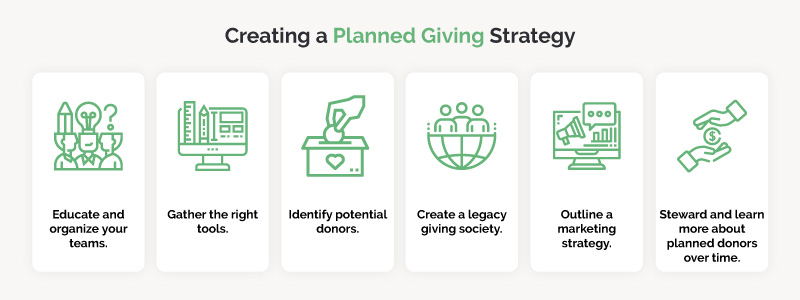
Set up and educate your groups.
Resolve your targets and decide who will lead your deliberate giving efforts (normally a member of your growth or fundraising division). Educate the members of your fundraising, advertising and marketing, or communications groups and another employees who will play roles in your program.
Construct the muse; safe board governance & management buy-in.
A profitable program launch requires specific approval, strategic backing, and energetic participation from the board of administrators. Board members function fiduciary stewards of the group, and their endorsement indicators institutional stability to potential legacy donors. Securing buy-in includes presenting a transparent enterprise case that highlights how legacy giving mitigates long-term monetary threat with out depleting present operational sources.
To formalize this dedication, the board of administrators should move an official decision establishing the deliberate giving program. This decision grants management the authority to simply accept deferred presents, set up devoted accounting funds, and execute crucial administrative protocols.
Craft an in depth present acceptance coverage.
Reward Acceptance Insurance policies (GAP) function an operational framework, defending the group from liabilities related to burdensome, restricted, or illiquid presents. With out outlined tips, a corporation dangers accepting property that value extra to liquidate or preserve than their precise market worth, comparable to contaminated actual property or extremely restricted intently held inventory.
A complete Reward Acceptance Coverage defines which property the group will settle for robotically, which require particular board evaluate, and which should be declined outright. It establishes normal valuation standards, authorized counsel evaluate triggers, and clear guidelines relating to donor restrictions.
| Acceptance Standards | Major Threat Vector | Required Oversight | |
| Money & Equivalents | Accepted instantly upon receipt | Minimal | Normal Accounting |
| Publicly Traded Inventory | Accepted; liquidated upon receipt | Market volatility previous to switch | Finance Director |
| Actual Property | Requires Part I Environmental Website Evaluation | Environmental liabilities, tax liens | Board Evaluate Committee |
| Cryptocurrency & Digital Property | Accepted by way of certified liquidating processor | Excessive volatility, safety dangers | CFO & Tech Committee |
| Privately Held Enterprise Fairness | Requires impartial appraisal & exit path | Unrelated Enterprise Revenue Tax (UBIT) | Authorized Counsel & Board |
Moreover, administrative insurance policies should define how realized property funds are distributed internally. Organizations ought to specify what proportion of unrestricted property presents goes into long-term endowment reserves versus instant capital initiatives or operational contingencies, making certain clear fiscal administration throughout board transitions.
Put together a step-by-step launch timeline.
Launching a program requires a methodical sequence of actions unfold over a multi-month timeline. Advertising and marketing complicated present constructions instantly with out correct backend infrastructure results in administrative confusion, sluggish donor response occasions, and potential compliance points. A structured timeline breaks the launch into distinct phases centered on readiness, messaging, and outreach.
- Part 1: Infrastructure and governance (Months 1–2)
- Safe board authorization and move this system decision.
- Draft and ratify complete Reward Acceptance Insurance policies.
- Put together standardized bequest language (pattern codicil clauses) for attorneys and donors.
- Set up devoted authorized and accounting oversight relationships.
- Part 2: Advertising and marketing integration and collateral (Months 3–4)
- Publish a transparent, accessible legacy givers touchdown web page on the group’s area or devoted microsite.
- Replace digital transaction confirmations and print collateral to incorporate delicate bequest prompts.
- Create downloadable informational guides detailing easy property planning choices.
- Combine legacy curiosity check-boxes into normal annual giving types and surveys.
- Part 3: Direct outreach and legacy society rollout (Months 5–6)
- Analyze CRM donor historical past to determine long-term, loyal contributors (donors with 5+ years of steady help no matter present measurement).
- Launch a proper Legacy Society to acknowledge people who’ve included the group of their property plans. This may domesticate a sense of neighborhood and inclusion in your group, particularly if it comes with perks like public acknowledgment or entry to particular occasions.
- Conduct customized outreach to loyal donors, board alumni, and long-standing volunteers.
- Set up an annual stewardship cadence to maintain legacy society members knowledgeable and engaged.
Executing this phased roadmap retains inner groups aligned and prevents operational bottlenecks. By constructing the authorized, monetary, and digital basis first, the group ensures that when advertising and marketing outreach generates donor inquiries, each request is dealt with effectively and professionally.
Collect the fitting instruments.
Scaling a legacy giving initiative with out increasing administrative overhead requires trendy donor seize know-how and automatic CRM integration. Figuring out legacy donors typically depends on monitoring delicate behaviors, comparable to constant micro-donations over time, frequent visits to deliberate giving webpages, or engagement with property planning sources.
Nonetheless, you’ll want instruments to market your program, observe donation knowledge, and assist donors arrange their deliberate presents. Search for a deliberate giving platform that provides donors free will creation instruments and supplies you with the information it’s essential observe up and steward your relationships with them over time.
Establish potential candidates and work on stewarding them over time.
When in search of prospects, begin with these most devoted to your trigger, together with board members, volunteers, and longtime donors. Ask about their consciousness of and curiosity in deliberate giving (and in the event that they’ve already created a deliberate present). Use these responses to construct an preliminary prospect checklist, get a way of their shared traits, and refine your strategy as you be taught extra.
As you start asking for and receiving deliberate presents, actively work to maintain these donors concerned and engaged. Study extra about why they select to offer to tell your future methods.
Don’t be afraid to start out small. Your deliberate giving program can develop. By starting with a focused deal with easier presents like bequests, you’ll be able to lay out an efficient framework for ultimately asking for extra complicated deliberate presents or various kinds of non-cash presents over time.
The hot button is to continue learning extra and refining your strategy as you go. Your growth workforce already probably follows greatest practices for conducting prospect analysis, qualifying donors, constructing relationships, and stewarding donors. Use and adapt these methods to your new deliberate giving targets.
What are some useful templates and sources for deliberate giving?
1. Board Decision Template for Deliberate Giving
Earlier than launching a deliberate giving technique, your group wants formal authorization from its board of administrators. A board decision establishes this system’s official legitimacy, authorizes employees to simply accept legacy presents, and units clear administrative tips.
BOARD RESOLUTION OF [NONPROFIT NAME]
ESTABLISHING A PLANNED GIVING PROGRAM

WHEREAS, [Nonprofit Name] is dedicated to securing its long-term monetary stability and advancing its mission to [briefly state mission]; and

WHEREAS, deliberate giving gives supporters a significant approach to supply lasting help by means of bequests, trusts, and different property planning autos;

NOW, THEREFORE, BE IT RESOLVED that the Board of Administrators of [Nonprofit Name] hereby approves the creation of an official Deliberate Giving Program.

BE IT FURTHER RESOLVED that:
1. The Government Director and Growth Employees are approved to actively promote and domesticate deliberate presents, together with bequests, beneficiary designations, and charitable trusts.
2. All deliberate presents shall be administered in accordance with [Nonprofit Name]’s established Reward Acceptance Coverage.
3. Until in any other case designated by the donor, legacy presents acquired shall be directed to [Nonprofit Name]’s Endowment Fund [or Board-Restricted Reserve Fund] to help long-term organizational sustainability.

Handed and adopted this [Date] day of [Month], [Year].

Board Chair Signature: ___________________________ Date: ____________
Secretary Signature: ______________________________ Date: ____________
2. Legacy Giving Pattern Language Templates
Donors typically need to embody your nonprofit of their property plans, however friction within the drafting course of can stall their efforts. Clear, customizable pattern bequest language makes it simple for supporters and their property planning attorneys to incorporate your group in wills or dwelling trusts.
Possibility A: Particular Bequest
Use this language when a donor needs to go away a selected greenback quantity or asset.
“I give, devise, and bequeath to [Nonprofit Name], positioned at [Address] (Tax ID/EIN: [XX-XXXXXXX]), the sum of $[Amount] for use for its normal charitable functions.”
Possibility B: Residual Bequest
Use this language when a donor chooses to go away a proportion of their remaining property after different distributions have been glad.
“I give, devise, and bequeath to [Nonprofit Name], positioned at [Address] (Tax ID/EIN: [XX-XXXXXXX]), [Percentage]% of the rest of my property, each actual and private, for use for its normal charitable functions.”
Possibility C: Contingent Bequest
Use this language when a donation ought to solely happen if main beneficiaries predecease the donor.
“If [Name of Primary Beneficiary] doesn’t survive me, I give, devise, and bequeath to [Nonprofit Name], positioned at [Address] (Tax ID/EIN: [XX-XXXXXXX]), [Percentage]% of my property for use for its normal charitable functions.”
3. Pattern Reward Acceptance Coverage (Bequests and Deliberate Items)
A transparent Reward Acceptance Coverage manages donor expectations, protects your group from burdensome liabilities, and ensures all authorized requirements are met. Use the template beneath to outline how your group accepts bequests and different legacy presents.
GIFT ACCEPTANCE POLICY: PLANNED GIFTS AND BEQUESTS

1. Function
This coverage governs the acceptance of deliberate presents made to [Nonprofit Name]. It ensures that every one presents align with our mission and moral fundraising requirements.

2. Outright Bequests
* [Nonprofit Name] accepts bequests from wills and revocable trusts.
* Donors are inspired to help unrestricted normal operations to offer the group most flexibility.
* Restricted bequests will likely be reviewed by the Government Director and Board Treasurer previous to acceptance to make sure the restriction aligns with organizational capacities and packages.

3. Beneficiary Designations
* [Nonprofit Name] accepts designations as a beneficiary of retirement plans (e.g., 401(ok), IRA), life insurance coverage insurance policies, and industrial annuities.

4. Actual Property and Tangible Private Property
* Deliberate presents involving actual property, intently held inventory, or bodily property should be reviewed by the Board of Administrators previous to formal acceptance.
* The evaluate will assess potential liabilities, carrying prices, marketability, and environmental dangers.

5. Authorized and Monetary Counsel
* [Nonprofit Name] urges all potential donors to hunt impartial authorized and monetary recommendation when drafting property plans.
* Employees members shall not draft authorized paperwork or function executors for donor estates.
Disclaimer: The pattern templates and language supplied above are for instructional functions solely and don’t represent formal authorized or tax recommendation. Nonprofit organizations and potential donors ought to seek the advice of with certified authorized counsel, monetary advisors, or tax specialists to make sure all paperwork adjust to relevant native, state, and federal legal guidelines and align with particular organizational wants.
Last ideas on growing your deliberate giving technique
Launching a profitable deliberate giving program requires a robust basis, clear insurance policies, and the fitting instruments. By establishing board governance, creating present acceptance tips, and following a phased roadmap, your group can flip long-time donor loyalty into long-term monetary power.
Utilizing know-how to seize donor intent makes it simple to develop your legacy pipeline with out including heavy administrative work to your workforce. Over time, these future property commitments create a dependable monetary cushion. That stability ensures your nonprofit can fulfill its mission for generations to return.
Focused on extra sources? Try these suggestions from our workforce:
- Deliberate & Legacy Giving Statistics — Study extra concerning the state of deliberate giving right now, and what the way forward for legacy gifting is predicted to carry.
- Strikes Administration — Study the fundamentals of easy methods to preserve observe of donor interactions as you’re employed in the direction of a selected objective like making a deliberate present.
- Nonprofit Fundamentals – Uncover extra nonprofit administration and fundraising necessities by exploring our different introductory guides and glossary entries.