


The federal government are rumored to be elevating taxes on banks within the finances – here is why they need to go additional
Rumours are rife that taxes will probably be raised on banks in Burnham’s first finances on Wednesday. That is hardly shocking information: the federal government is underneath stress to lift funds however has dominated out tax will increase “on working folks”, together with revenue tax, nationwide insurance coverage, and VAT. In the meantime, banks are posting report income.
Taxing banks is difficult. Completely different proposals have totally different strengths and weaknesses, and work together with different suggestions (eg tiering reserves, for which NEF has lengthy advocated). However when you think about the choices accessible to the federal government, and big windfalls loved by banks, the model the federal government appears poised to select doesn’t go far sufficient.
Why it’s honest to tax the banks
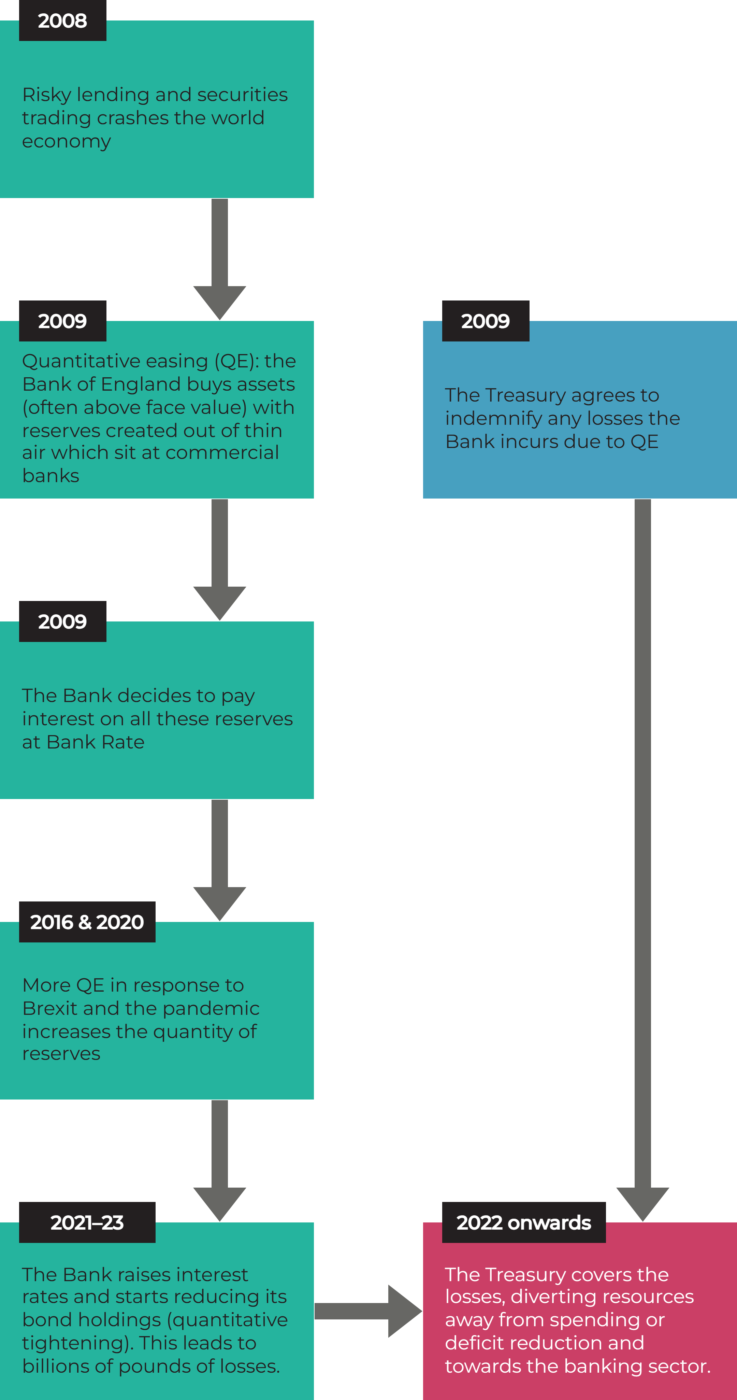
Business banks are having fun with a windfall of extra income for 2 fundamental causes. First, they’re receiving billions from the general public purse on account of quantitative easing (QE), the choice the Financial institution of England made to remunerate all reserves, and the very fact the Treasury indemnifies the Financial institution’s losses. That is summarised in Determine 1. The bonds the Financial institution has purchased since 2009 have earned it some curiosity, however at a low, mounted price, whereas the curiosity it pays out to industrial banks has risen with the Financial institution price. The bought bonds have additionally fallen in worth, largely for a similar motive. The mix of those elements has left the general public sector with a large anticipated lifetime loss: £164bn based on the newest official figures (though not too long ago introduced adjustments to the quantitative tightening course of will possible trim this). NEF has beforehand described this as a “stealth subsidy” to the banking sector.
Determine 1: A timeline of how selections by the Financial institution of England and the Treasury have led to billions being transferred to industrial banks from the general public purse.
Second, banks are profiting on the distinction between rates of interest for lending and saving, notably by not passing charges on to savers, the place folks’s unwillingness to “store round” offers banks extra market energy. That is all the time a part of banks’ enterprise mannequin, however the hole tends to extend when rates of interest are greater.
Collectively, these create a robust case for taxing banks. In addition to elevating income, a tax may claw again a subsidy they’ve been receiving from the state, and goal the extra income they make ensuing from market energy quite than productive exercise.
What would greater taxes on banks appear like?
A number of organisations have revealed concepts on elevate financial institution taxes, together with Constructive Cash, the TUC, and IPPR. Proposals are sometimes influenced by what different nations have tried, notably Spain’s windfall tax design. To know these proposals, we should first perceive how banks are at present taxed; that is summarised in Field 1.
|
Field 1: A proof of financial institution taxes within the UK Banks pay company tax on their UK income like another UK firm. After the monetary crash, a Financial institution Levy was launched, with two (considerably conflicting) goals: to cut back riskiness within the banking sector, and to lift income. It got down to accomplish this by taxing short-term liabilities (12 months or much less) on financial institution stability sheets at a sure price, and taxing long-term liabilities at half this price. Over time, income raised from this levy fell, partly as a result of it achieved its goal of decreasing riskier funding, partly as a result of the speed was reduce (after lobbying from the sector), and partly as a result of its scope was restricted to UK stability sheets, on account of fears about relocation and worldwide competitiveness. At present, it quantities to a small however important share of the sector’s tax contribution (typically equal to 1 – 3% of pre-tax revenue for bigger banks), various over time and between establishments. As well as, banks pay a surcharge on company tax, launched in 2016, to make sure that they “make a good contribution in respect of the potential dangers they pose to the UK monetary system and wider economic system”. The surcharge is basically a further quantity of company tax banking teams pay on income above £100m (initially £25m) with some minor variations. This was launched particularly to compensate for losses in income from decreasing the levy and successfully signifies that domestically centered banks (for whom UK stability sheets and income are extra necessary) shoulder the next burden than massive worldwide teams (resembling HSBC). Company tax has fallen considerably since its Seventies peak, from 52% steadily all the way down to 19%. When the federal government launched plans to extend the speed to 25% in 2021, it reduce the surcharge from 8% to three%, justifying this on the grounds of worldwide competitiveness. |
Designing a brand new tax for banks boils all the way down to a collection of easy decisions, as follows
- Revenue vs. revenue: Present taxes primarily goal banks’ income, resembling company tax and the surcharge. Some new proposals goal revenue as an alternative – particularly web curiosity revenue, which encompasses the principle sources of extra positive aspects for banks (curiosity on QE-era reserves and the hole between mortgage and financial savings charges). Revenue taxes are simpler to dodge, as a result of income are simpler to therapeutic massage, however taxing revenue on this approach is much less precedented and due to this fact might end in extra resistance from the sector.
- Whether or not to incorporate charges and commissions: If a tax proposal targets curiosity revenue, it might or might not embody charges and commissions. Since these may be designed in a approach that artificially limits curiosity revenue, if a tax doesn’t embody them in its base it ought to embody a transparent rule that charges or commissions utilized in lieu of curiosity funds are taxed as curiosity revenue could be.
- Anti-avoidance guidelines: The UK financial institution surcharge incorporates guidelines which limit some types of avoidance (a few of which apply equally to company tax usually). The unique type of the Spanish windfall tax utilized in 2023 and 2024 imposed heavy penalties for passing prices on to prospects (eg by way of greater mortgage charges, decrease financial savings charges, or greater charges), with fines equal to 150% of the passed-on prices.
- Focused vs. common: Most proposals use the sources of extra revenue we describe as a part of a common narrative justifying a further tax. Others, resembling IPPR’s proposal, give attention to a particular supply of extra revenue (of their case curiosity revenue on QE-era reserves).
- Time horizon: Windfall taxes are normally time-limited, or linked to a particular supply of extra revenue. Shorter-term taxes may be extra politically viable, but in addition can introduce intertemporal avoidance (ie by shifting income into later home windows). Particular guidelines can restrict this. For instance, the Vitality Income Levy – a windfall tax on oil and gasoline corporations – limits the scope for intertemporal loss aid.
- Inside or past jurisdiction: To keep away from fears of relocation or revenue migration, some proposals focus solely on positive aspects made within the UK, or by entities that may discover it more durable to go away the UK. There’s a trade-off right here between competitiveness and equity if all banks have gained from a windfall, however the least cellular banks are extra closely focused. This even applies to current taxes: when the Financial institution Levy was decreased and the surcharge launched, smaller UK-focused banks complained that they might shoulder an elevated share of the tax burden relative to banks with massive abroad operations.
- The extent: How excessive ought to the tax price be? This might rely upon a income goal or view of the diploma of extra revenue banks have been making; fears about compliance, resistance or avoidance; and the downstream affect on credit score circumstances. Revenue is greater than revenue, so taxes that concentrate on it are stronger on the similar headline price (roughly twice as robust based mostly on our inside modelling).
A number of the most outstanding proposals for elevated taxes on banks, which have been described in earlier NEF publications, are summarised in Desk 1. This desk consists of the taxes really applied in Spain, in addition to proposals which may very well be adopted within the UK.
Desk 1: An summary of proposals for elevated taxes on banks
|
Tax |
Revenue or revenue? |
Charges and comissions |
Price |
When it ends |
Retail banks |
Funding banking arms |
International banks’ native operations |
|
Spanish windfall tax (unique 2023 – 24 design) |
Revenue (web curiosity revenue) |
Included: added to web curiosity revenue |
4.8% of all web curiosity revenue, for banks with a minimum of €800m of gross curiosity and charge revenue in 2019 |
After two years |
Sure |
Sure |
Subsidiaries: sure; branches not named |
|
Spanish windfall tax (new design 2025 – 26) |
Revenue (web curiosity revenue) |
Included: added to web curiosity revenue |
1% to 7% in bands, on revenue above €100m |
After three years |
Sure |
Sure |
Sure |
|
Revenue (web curiosity revenue) |
Included: added to web curiosity revenue |
38% of revenue above £800m |
Not specified |
Sure |
No |
Not specified |
|
|
Revenue |
Included not directly, as a part of revenue |
Surcharge raised from 3% to eight%, 16% or 35%, on revenue above £100m |
Might be time restricted and reviewed on the finish of the parliament |
Sure |
Sure |
Sure |
|
|
IPPR (impressed by Thatcher-era levy) |
Revenue (curiosity the Financial institution of England pays on reserves) |
Excluded |
All reserve curiosity revenue above a 2% price, on reserves above an allowance (eg 1% of sterling property), for banks with over £25bn of sterling property |
Routinely, as soon as QE is unwound or Financial institution Price falls to 2% |
Sure |
Sure |
Sure |
How a lot may a tax elevate?
1. What’s John Healey more likely to do?
The hearsay mill has been awash with claims during the last week that the federal government intends to lift taxes on banks, particularly by restoring the surcharge to eight% in step with essentially the most modest of the TUC’s suggestions.
Income projections for this proposal to the top of this parliament function in Desk 2. The TUC’s proposal mentions the potential to evaluate this resolution on the finish of the parliament: if this occurred or the surcharge have been deliberate to be momentary, the affect on headroom would possible be decrease than within the desk, partly due to the shorter time window, but in addition due to intertemporal avoidance (shifting income into later years).
Desk 2: Income projections for restoring the surcharge to eight%
|
2026/27 (From 1 Jan 2027) |
2027/28 |
2028/29 |
2029/30 |
Complete |
Affect on headroom (stability rule) |
|
|
All banks |
£0.4 – 0.5bn |
£1.8 – 2.2bn |
£1.8 – 2.4bn |
£1.8 – 2.5bn |
£5.8 – 7.6bn |
+ £2.0 – 2.8bn |
|
“Massive 4” solely |
£0.2 – 0.3bn |
£1.0 – 1.2bn |
£1.0 – 1.3bn |
£1.0 – 1.4bn |
£3.2 – 4.2bn |
+ £1.1 – 1.5bn |
Supply: NEF evaluation. For extra element, see the underside of this weblog.
2. What would we suggest?
Healey’s possible plan of action is welcome, however inadequate. It solely represents an additional £2bn or so in annual taxes towards report–excessive income of round a billion kilos per week, a lot of which is ensuing from a direct switch from the state to the sector. It could take a long time for a tax of this nature to reclaim this stealth subsidy, with out even contemplating extra income from weak pass-through to savers.
Determine 2 illustrates this, highlighting the comparatively small affect that growing the surcharge to eight% would have as a fraction of the income of the large 4 banks within the 2027/28 fiscal yr. The projection of financial institution income used for this chart is sort of conservative; whether it is certainly an underestimate, the proportion assigned to different taxes may simply fall, decreasing the estimated tax burden.
Determine 2: The place the large 4 UK banks’ income would go 2027 – 28
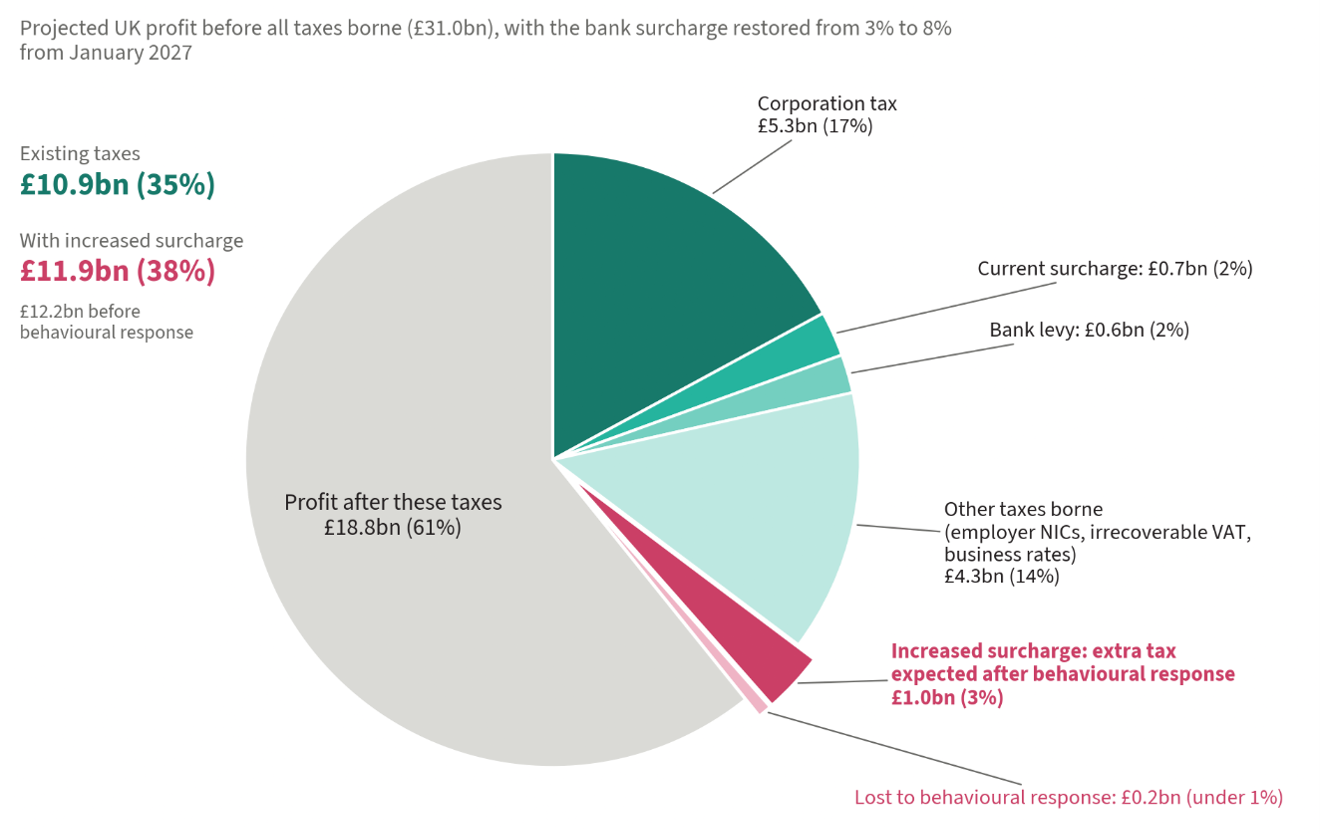
Supply: NEF evaluation
From a income–elevating perspective, this modest tax wouldn’t have a robust affect on fiscal headroom, nor may it fund a lot in the way in which of inflation-busting funding or price of dwelling assist. If that is certainly what’s introduced on Wednesday, it might appear that the federal government has made concessions to monetary sector lobbying in implementing the smallest doable model of this tax.
The federal government ought to go additional and intentionally purpose to get better the positive aspects from curiosity on QE-era reserves obtained by industrial banks. NEF has lengthy advocated for tiering reserves, and we nonetheless assume that’s one of the best ways to minimise QE-linked stealth subsidies in future. Nevertheless, the federal government may obtain the same final result with a well-designed tax. The truth that transfers from the Financial institution of England to banks are being underwritten by the federal government – that these transfers signify an oblique subsidy from the Treasury to industrial banks – means there’s a robust case for implementing such a measure.
If the federal government aimed to get better this cash by the top of the deliberate quantitative tightening schedule in 2034, this may imply elevating an order of magnitude greater than the modest surcharge enhance proposal. This could necessitate a a lot greater price, in all probability achieved partly by concentrating on revenue as an alternative of revenue as was accomplished in Spain, and because the different proposals describe. It could possible be hindered by each avoidance and authorized problem, though it may very well be designed in a approach that limits the danger and diploma of offshoring.
Whereas we needs to be clear-eyed in regards to the challenges, we should always not allow them to derail the case for bolder financial institution taxes. Banks obtained extraordinary assist after the monetary disaster, through bailouts and QE, whereas only a few bankers suffered any actual penalties for the crash their sector triggered. They proceed to obtain a subsidy by stealth that eats away on the authorities’s potential to pursue different priorities, whereas unusual households face a value of dwelling disaster and the nation suffers for an absence of public funding. It’s affordable that banks pay their share to treatment this.
Full methodology observe accessible right here.
Picture: iStock

