


Bank card delinquency rose sharply between 2022 and 2024, and the rise was steepest amongst debtors in lower-income neighborhoods. Right here, we test in on bank card efficiency by neighborhood revenue and hint when the debtors who at the moment are scuffling with their funds have been issued playing cards. We discover that throughout the pandemic, an growing share of latest bank cards went to debtors with decrease incomes and credit score scores, and people accounts at the moment are exhibiting larger ranges of misery.
This evaluation accompanies the newest Quarterly Report on Family Debt and Credit score, by the New York Fed’s Middle for Microeconomic Knowledge. The report exhibits that whole nominal family debt balances elevated by $334 billion within the third quarter of 2026, a 1.8 p.c enhance from the second quarter of 2026. Though delinquency charges for mortgages worsened barely, transition charges into critical delinquency have been largely unchanged throughout non-housing debt varieties.
Notice: The Quarterly Report and this evaluation are primarily based on the New York Fed Shopper Credit score Panel, which is drawn from anonymized Equifax credit score experiences.
A Widening Hole by Neighborhood Earnings
We start our evaluation by exhibiting tendencies within the charge of newly delinquent bank card balances segmented by quartiles of common zip code revenue. These delinquency charges declined for all teams and converged throughout the pandemic, when forbearances, stimulus funds, and diminished consumption led to improved fee habits. Since 2022, nevertheless, this measure of family misery worsened. Latest delinquency charges are larger than pre-pandemic ranges for all teams, and the hole between debtors residing in higher-income neighborhoods and lower-income neighborhoods has expanded.
The Credit score Card Delinquency Hole Between Low-Earnings and Excessive-Earnings Areas Widened After 2022
Stream into critical delinquency
Notes: Zip revenue quartile (1 = lowest). The movement into critical delinquency is outlined because the p.c of steadiness not 90+ days overdue within the earlier quarter that grew to become 90+ days overdue within the present quarter, proven as a four-quarter transferring sum. Debtors are divided into 4 quartiles of equal inhabitants by the imply adjusted gross revenue of their zip code.
As beforehand famous, this surge partially represents a reversal of pandemic-era dynamics: federal financial stimulus compressed delinquency charges throughout the pandemic, however right this moment, most households have exhausted their pandemic-era financial savings and most fiscal and financial helps have ended. As well as, macroeconomic headwinds —particularly excessive inflation and rising borrowing prices —have squeezed shoppers, with inflation outpacing wage progress for low-income brackets.
Loosening Credit score Requirements In the course of the Pandemic
Though macroeconomic circumstances have been probably the primary contributing issue to the discount and subsequent enhance in delinquency charges, we additionally discover whether or not the pandemic-era loosening in credit score provide performed a task. In the course of the pandemic, deferments, forbearances, and mortgage modifications contributed to growing credit score scores as a result of many debtors who would have in any other case been reported overdue averted delinquency. Concurrently, robust client demand mixed with low rates of interest might have prompted some lenders to ease underwriting requirements and prolong credit score to these beforehand not served.
Within the chart under, we plot the share of latest bank cards (blue) and new credit score limits (crimson) in every quarter prolonged to debtors within the lowest quartile of neighborhood revenue (the identical group comprising the blue line within the first chart). At the beginning of the pandemic, the share of latest playing cards and credit score limits going to those debtors every rose by almost 2 share factors, and the shares remained elevated till 2023, according to lenders easing underwriting requirements throughout that interval.
Extra Playing cards and Credit score Have been Issued to Debtors in Decrease-Earnings Areas Between 2020-22
Share Prolonged to Debtors within the Lowest Zip Earnings Quartile
% of latest originations
Notes: The movement into critical delinquency is outlined because the p.c of steadiness not 90+ days overdue within the earlier quarter that grew to become 90+ days overdue within the present quarter, proven as a four-quarter transferring sum. Debtors are divided into 4 quartiles of equal inhabitants by the imply adjusted gross revenue of their zip code.
Proof from credit score scores additional confirms this easing. The chart under exhibits that the median credit score rating at card issuance fell from a mean of 699 in 2017–19 (inexperienced area) to 688 throughout the 2020–22 interval (crimson area). Notably, the decline in median credit score rating at origination probably understates the extent of easing since credit score scores within the inhabitants have been typically growing throughout the identical time, as proven within the blue line. Nonetheless, this development reverted towards the top of 2022, just like the development in card issuance to low-income areas, with median credit score scores for brand spanking new playing cards for more moderen vintages surpassing the pre-pandemic (inexperienced) period.
Pandemic-Period Credit score Card Originations Had Decrease Credit score Scores
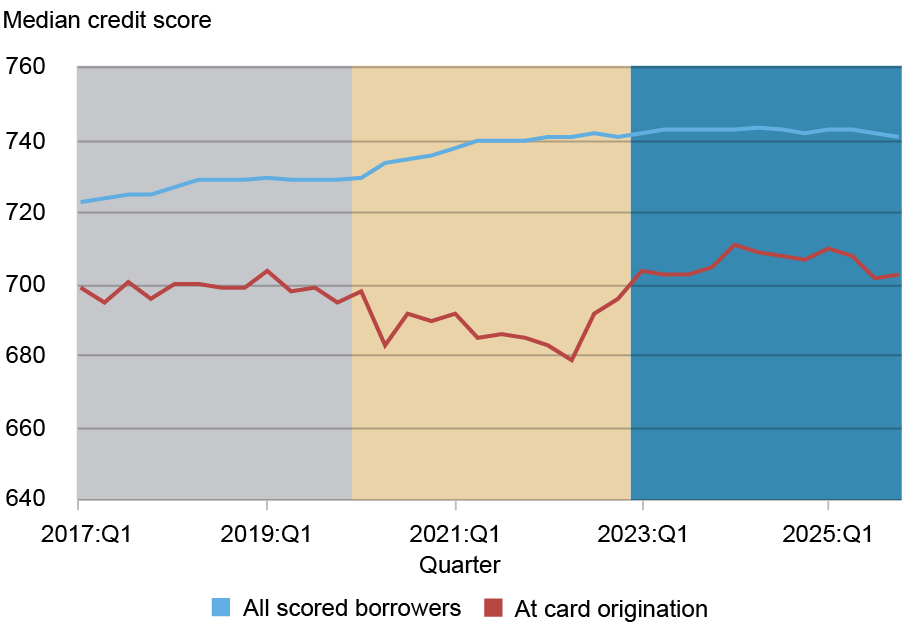
Notice: Credit score rating is Equifax Danger Rating 3.0.
Subsequent, we discover how every of those vintages carried out given their diversified credit score high quality at issuance. The chart under decomposes our critical delinquency transition charge, the share of balances that grew to become newly 90 or extra days delinquent, by the identical three vintages within the chart above together with the playing cards issued previous to 2017. Right here we see an identical sample throughout most vintages. Most new delinquencies in every quarter come from more moderen vintages, as newly opened “unseasoned” money owed have traditionally been the almost certainly to fall overdue. The playing cards issued previous to 2017 had already reached their peak delinquency charge by 2018 and have been waning of their contribution to the entire all through the sequence.
In the meantime, the 2017-19 classic reached its comparatively low peak throughout the pandemic period the place forbearances and financial and financial helps helped produce historic lows in delinquency. Then again, the 2020-22 classic confirmed a fast rise and excessive peak all through 2023 and into 2024 the place it made up a large share of latest delinquencies throughout all vintages, maybe because of the comparatively decrease credit score high quality of this classic. Notably, playing cards issued since early 2023 have typically gone to debtors with larger scores.
The Impact of the Pandemic-Period Classic is Waning
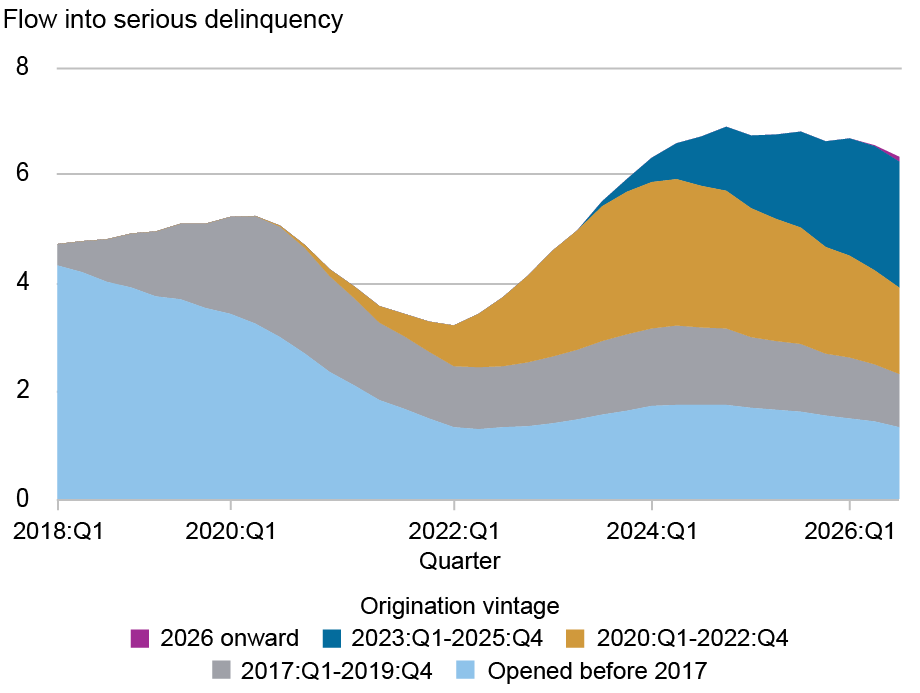
Supply: New York Fed Shopper Credit score Panel/Equifax.
What Does This Imply for Delinquency Charges Shifting Ahead?
Delinquency charges for playing cards issued throughout the pandemic are abating. If present patterns maintain, the elevated delinquencies of the previous few years might show to be extra of a pandemic-era echo than a everlasting function of the bank card market—one which will proceed to fade as 2020-22 vintages make up a shrinking (and positively chosen) share of “surviving” playing cards.
In fact, since newer playing cards usually tend to fall overdue, the biggest issue for near-term delinquency charges is the credit score high quality of essentially the most lately issued playing cards. So far via 2025, the credit score high quality of latest issuances, as captured by origination credit score scores, is under that of 2024 however above the degrees of the pre-pandemic and pandemic eras. So, absent macroeconomic shocks, we anticipate that new bank card delinquencies will probably proceed to see indicators of enchancment, and we’ll proceed to watch the tendencies in card efficiency within the coming quarters.

Donghoon Lee is an financial analysis advisor within the Federal Reserve Financial institution of New York’s Analysis and Statistics Group.

Daniel Mangrum is a analysis economist within the Federal Reserve Financial institution of New York’s Analysis and Statistics Group.

Joelle W. Scally is an financial coverage advisor within the Federal Reserve Financial institution of New York’s Analysis and Statistics Group.

Tejas Sinha is a analysis analyst within the Federal Reserve Financial institution of New York’s Analysis and Statistics Group.

Wilbert van der Klaauw is an financial analysis advisor within the Federal Reserve Financial institution of New York’s Analysis and Statistics Group.
Easy methods to cite this put up:
Donghoon Lee, Daniel Mangrum, Joelle W. Scally, Tejas Sinha, and Wilbert van der Klaauw, “A Take a look at the Wider Divide in Credit score Card Delinquency by Earnings,” Federal Reserve Financial institution of New York Liberty Road Economics, November 10, 2026, https://doi.org/10.59576/lse.20261110
BibTeX: View |
Disclaimer
The views expressed on this put up are these of the creator(s) and don’t essentially mirror the place of the Federal Reserve Financial institution of New York or the Federal Reserve System. Any errors or omissions are the accountability of the creator(s).
