

A UK Guardian editorial final week (November 3, 2026) – The Guardian view on Labour’s progress obsession: a distinct economics is feasible – challenges the dominant obsession with attaining ever sooner ranges of GDP progress that, partly, is linked to the fictions superior about fiscal capability – viz, nations will need to have progress to generate the tax income to pay for presidency companies. On October 30, 2026, I gave a presentation in Tokyo difficult this obsession and advancing the concept Japan is completely positioned to steer the world right into a degrowth section of human growth, one that may assist cut back the ecological footprint and underpin an environmentally sustainable future. On this submit, I present a abstract of the presentation.
Background
The title of the presentation was “Fiscal enlargement: scope and points” and the context was the present plan by the Takaichi authorities in Japan to introduce a significant fiscal stimulus to kick-start a better progress fee.
I coated two broad areas within the presentation:
1. What scope is there for fiscal enlargement and is the labour market actually that tight in Japan?
2. Would a low progress (degrowth) technique be the neatest method given the constraints.
Inside these areas three coverage priorities have been outlined:
1. Maximise potential of inhabitants.
2. Guarantee advantages from progress are extra pretty distributed.
3. Cut back ecological footprint.
I additionally put the discuss within the context of the numerous challenges that Japan presently faces as summarised by this slide:
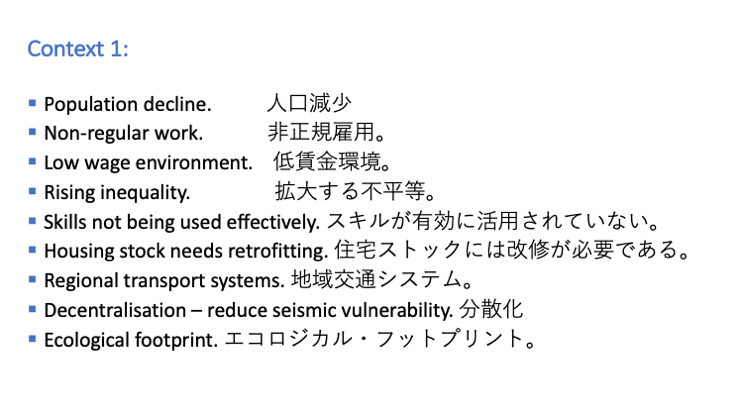
The articulation of the challenges is broadly accepted throughout the Japanese coverage circles.
What’s controversial is the best way to deal with them.
There are two dimensions to this controversy.
First, the mainstream view is that the one manner forward is for sooner financial progress.
Second, this view is offered with the declare that any fiscal enlargement geared toward producing such progress dangers fiscal collapse and the standard arguments are made about bond markets refusing to fund the federal government, that bond yields will undergo the roof, that the yen will plummet in worth and exacerbate the already excessive inflation danger, and so forth and so forth.
The second contextual component is that Japan is presently locked in a mindset of deflation (as summarised by the next slide):
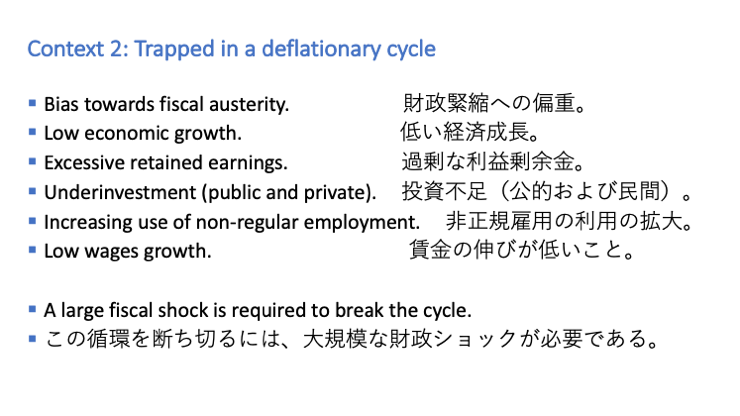
For the reason that asset bubble collapsed in the early Nineties, fiscal coverage has been biased in direction of austerity.
You would possibly ask how is it potential to run giant fiscal deficits constantly since that interval and construct up a sizeable public debt profile and be operating an austerity bias.
The truth is that the spending behaviour of the non-government sector has been so constrained that fiscal coverage needed to broaden to fill the spending hole.
Which introduces an vital level or nuance.
After I speak about austerity I’m referring to how shut the fiscal stance goes to filling the general spending hole, the latter being the distinction between the spending required to attain full capability utilisation (and full employment) and the precise spending.
If the non-government sector is selecting to avoid wasting of its earnings in every interval, then the one manner the financial system can keep away from recession (declining output and employment) is that if the federal government sector web spends (that’s, runs a deficit) to offset the non-government saving.
In any other case there’s a leakage from the expenditure-income loop (from the saving) which isn’t remedied by an equal injection (the deficit).
So an austerity bias doesn’t essentially imply a zero fiscal deficit or fiscal surplus.
It simply signifies that the federal government chooses to not fill the spending hole.
Austerity may additionally imply a really giant fiscal deficit – simply not giant sufficient, given the non-government spending and saving selections.
For the reason that bubble burst, Japanese companies have been sitting on giant shares of retained earnings as a result of they’ve been reluctant to spend money on new productive infrastructure.
Likewise, the federal government capital expenditure has been weak.
Additional, companies have been reluctant to rent common staff, preferring to interchange these everlasting positions with informal or non-regular appointments.
This has meant that total wages progress has been poor and this has influenced the consumption patterns of staff (total described as restrained).
Fiscal sustainability
The subsequent slide coated the standard Trendy Financial Concept (MMT) arguments about fiscal capability and I received’t rehearse them right here.
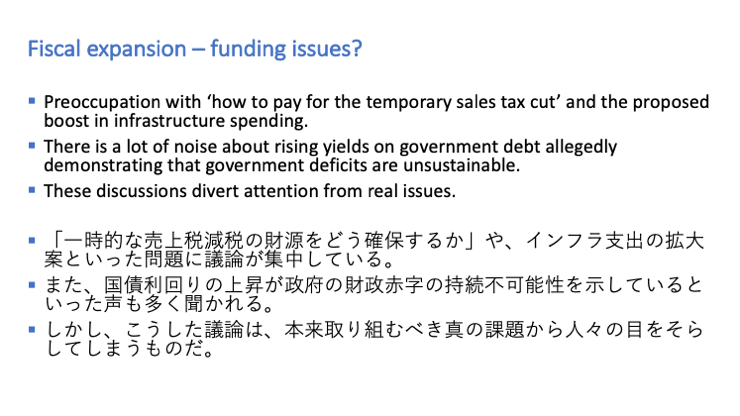
Basically, Japan can by no means have a public debt disaster everybody is aware of that the Japanese authorities can at all times meet its liabilities.
The fiscal restrict is the actual useful resource availability and monetary duty requires authorities to make sure no wasted assets.
Fiscal sustainability is about working inside the actual useful resource house, and, for a currency-issuing authorities is nothing to do with monetary house.
I identified that the rising bond yields had nothing a lot to do with the fiscal positions taken by governments however every part to do with the large demand for funds from the frontier AI firms at current.
I supplied this quote from the Australian Treasurer (Sydney, October 22, 2026) on the AI increase to place it into perspective:
Capital expenditure by the 5 largest hyperscalers in 2023 was $230 billion. It’s now forecast to quadruple to over $1.1 trillion …
To finance this, company bond issuances by hyperscalers have exploded. Annual issuance averaged round US$40 billion 5 years in the past, however is now projected to common round US$400 billion ($570 billion) within the subsequent few years.
I additionally famous that the Financial institution of Japan presently holds 46.7 per cent of all excellent Japanese Authorities Bonds and has demonstrated that it will possibly utterly management bond yields at no matter degree it chooses just by having the ability to outbid some other purchaser within the secondary bond market.
So underneath what unusual situation would a authorities that may dominate bond markets enable the latter to ship it broke?
Even casting the problem in that manner is pointless – the Japanese authorities doesn’t even must promote debt to the personal markets.
So it will possibly both not promote debt in any respect – sport over; or the Financial institution of Japan can management yields at any time when it desires to – sport over.
Two dimensions of actual useful resource availability
In assessing the scope for fiscal enlargement I selected to deal with two dimensions of useful resource capability:
1. Demographic tendencies – Will there be sufficient staff?
2. Environmental constraints – Ecological footprint concerns.
On the primary, the next slide summarised the problems:
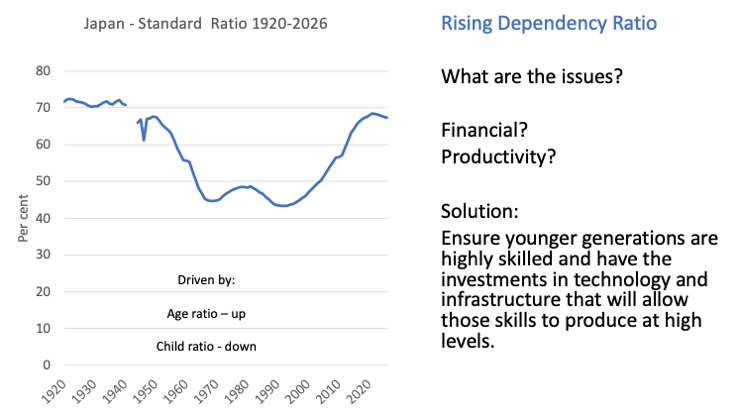
Japan’s inhabitants is ageing and by 2050 it’s projected to have fallen to 105 million (from present 123 million) and have a a lot older profile.
The mainstream argument is that this presents an enormous monetary drawback for governments – viz. how will the federal government fund the pension system and supply ever rising hospital care.
The answer then espoused is that the federal government has to ‘save up’ (by operating fiscal surpluses) which requires cuts to spending now.
The monetary arguments are spurious.
A currency-issuing authorities will at all times have the ability to fund pensions and well being care.
The problem is whether or not there’ll ample actual assets out there (for instance, docs, nurses and so forth) which may produce the required items and companies.
The problem is to make sure that the youthful technology of staff is extra productive than the earlier generations, provided that there might be much less staff supporting extra dependents (because the dependency ratio rises).
The opposite drawback is that specializing in monetary affordability, which then results in spurious calls for for spending cuts typically goal academic and coaching funding and so forth and people cuts really undermine the productiveness problem.
A complete technology of children buzzing round on scooters delivering meals is hardly going to immediate a productiveness revolution.
The answer for the demographic problem is to make sure youthful generations are extremely expert and have the investments in know-how and infrastructure that may enable these expertise to supply at excessive ranges.
The demographic problem can be linked to the talk about whether or not there’s a scarcity of labour or not.
Is there a scarcity of labour?
That is clearly a query that should be addressed after we assess the scope for fiscal enlargement.
The MMT deal with actual useful resource availability necessitates that we set up that the federal government wouldn’t simply be competing for staff already in productive use, which might generate inflationary pressures.
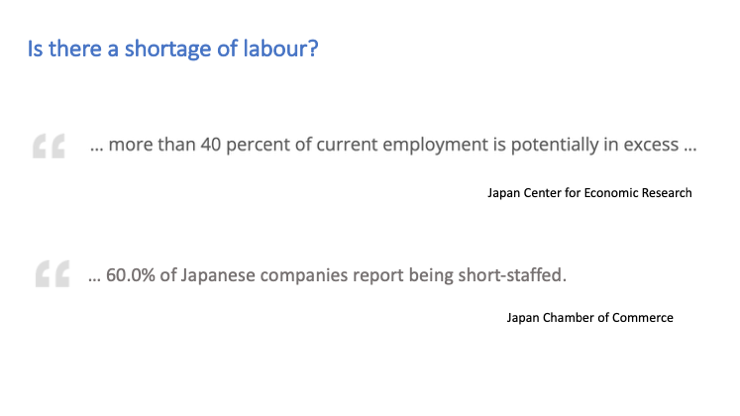
The subsequent slide juxtaposes two latest quotes and I mentioned that whereas they look like contradictory they’re in truth each correct.
There was numerous deal with the development trade, provided that the federal government plans a big injection into that sector by the use of infrastructure spending.
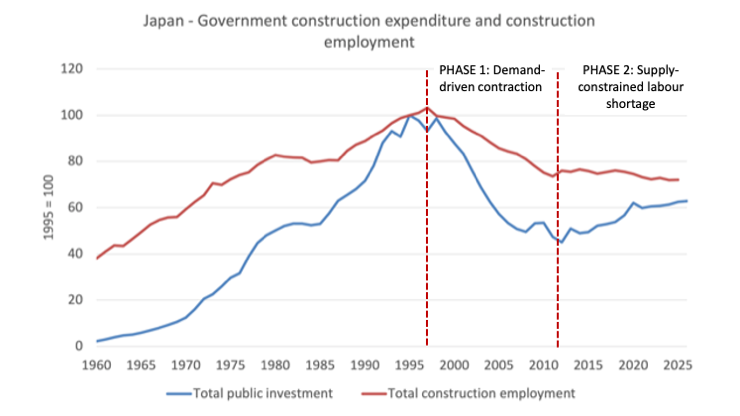
The subsequent slide reveals the historical past (from 1960) of Japanese authorities capital expenditure and employment within the building sector.
I’ve accomplished extra superior econometric modelling to discover the connection proven.
The overwhelming result’s that whole employment within the Japanese building has traditionally been pushed by the size of state procurement contracts out there.
After the bubble burst and the Japanese authorities was intimidated by mainstream economists into invoking an austerity bias, one of many foremost areas that the fiscal constraint was evident was capital funding.
Section 1 reveals this translated into a significant decline in building sector employment.
After the GFC, we entered what I name Section 2.
The federal government conscious of the necessity for elevated fiscal assist (albeit not sufficient of it) elevated capital expenditure a bit however building employment continued to fall, albeit at a gradual tempo.
The reason being that the sector got here up towards the demographic constraint of a declining inhabitants.
However the provide shortages went past the demographic decline.
Youthful folks eschewed working within the sector as a result of the circumstances are brutal (significantly by way of the climate extremes), the pay has been traditionally poor, the hours of labor lengthy, and the office relations are typified as authoritarian, with bullying by the bosses widespread.
Additional, misogyny is widespread which is very unattractive to girls staff who would possibly contemplate coming into the sector.
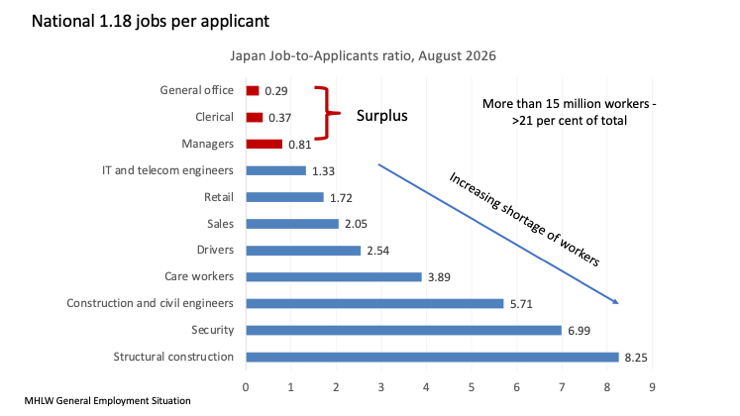
Additional proof of labour shortages in building come from inspecting the job-openings-to-applicants ratio throughout the occupations.
This measure is compiled by the Ministry of Well being, Labour and Welfare of Japan and is a broad measure of the relativity between labour demand and labour provide.
The upper the ratio the larger the scarcity of staff.
A ratio of 1 signifies that for each job on supply there’s somebody desirous to take it.
On the mixture degree the ratio in August 2026 was 1.18 which signifies a gentle scarcity of staff.
The aim of the slide is to reveal that there’s large variation throughout the occupational house.
For a few of the white collar jobs – there’s a surplus of staff.
These three occupations alone account for greater than 21 per cent of whole employment or greater than 15 million staff.
A ratio of 0.29 (Common workplace occupation) signifies that for each job opening there are round 3.5 staff in search of the job.
So in these occupations there’s undoubtedly not a scarcity of staff.
Nonetheless, in Structural building the ratio is 8.25 which means there are greater than 8 jobs on supply for each candidates – an enormous scarcity.
Additionally I famous that the share of non-regular employment in whole employment has been rising effectively above the OECD common since about 2008.
Non-regular staff now are at 21.3 million or 36.3 per cent of the workforce.
These jobs are usually low-paid, precarious, and low productiveness.
Within the June-quarter 2026 the info confirmed that:
Unemployment = 2.5 per cent.
Underemployment = 4.3 per cent.
Broad underutilisation (sum of each) = 6.8 per cent.
The implication is that rationalisation of those jobs into extra common employment may free vital assets with out impinging on output.
The conclusion I drew is that whereas there’s a scarcity of staff in some sectors, there are additionally surpluses of staff in different sectors.
Coverage must be geared toward creating transitions for staff from surplus to deficit sectors.
Environmental constraints
The second focus I selected was to focus on the environmental constraints that should be thought-about when designing a fiscal enlargement.
Usually, discuss of fiscal enlargement is tied in with a excessive progress obsession.
I questioned whether or not that was fascinating given each demographic and environmental constraints?
I argued {that a} smarter progress (degrowth) technique is extra aligned with the constraints.
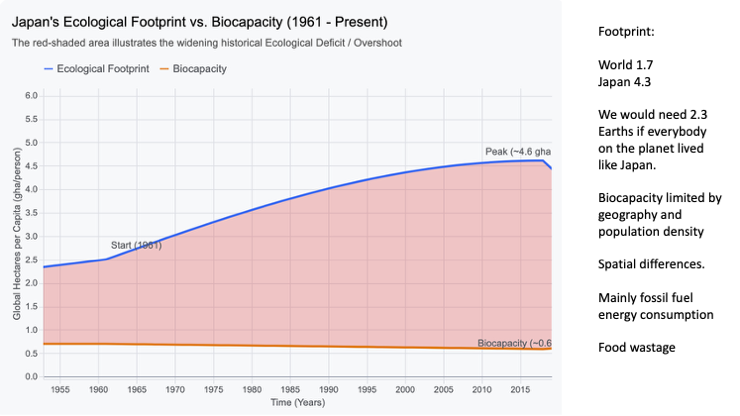
The subsequent slide focuses on Japan’s ecological footprint, which relates using assets towards the regenerative capability of the biosphere.
The ratio reveals the “quantity of biologically productive land and water space wanted to assist your life-style, produce the assets you eat (meals, timber, fiber), and take up your waste (akin to carbon emissions).”
The ratio for the whole globe is presently round 1.7 which implies humanity is working effectively past the regenerative capability of our pure surroundings.
For Japan, the ratio is 4.3.
Partially, it’s because Japan’s biocapacity is very constrained by its geography – a slender coastal fringe with excessive inhabitants density and plenty of mountains.
A lot of the consequence for Japan comes from fossil gasoline vitality consumption and excessive meals wastage.
I’ve identified earlier than how Japanese homes are excessive vitality customers, partly, as a result of, by design, they’re poorly designed and want fixed heating and cooling relying on the season.
Nonetheless, the {qualifications} apart, it’s irresponsible to be calling for sooner GDP progress if it means larger charges of useful resource utilization.
I then shifted into why degrowth is believable in Japan.
SMEs in Japan comprise round 99 per cent of enterprises and account for round 70 per cent of whole employment.
The SME possession in Japan is very weighted in direction of older staff:
- Higher than 60 per cent of homeowners are over 60 years of age.
- Round 15 per cent are over 75 years of age.
There are additionally cultural constraints on possession succession – promoting a enterprise when the proprietor will get too previous to run it isn’t the norm and the desire is handy the enterprise to a male relative.
The issue is that youthful staff don’t wish to tackle their father’s companies and so the attrition fee in these companies may be very excessive.
The Authorities has job forces set as much as enhance succession as a result of it fears the attrition fee will undermine the expansion potential for the nation.
There are main know-how initiatives in place to assist because the inhabitants shrinks.
For instance the iCONSTRUCTION 2.0 program which goals to automate and use robots as a lot as potential within the building sector.
However, I argue that the declining inhabitants and excessive attrition fee of SMEs supplies an ideal foundation for ditching the excessive progress obsession and as an alternative consolidating exercise right into a low (zero) progress posture.
The criticism is that this could injury the fabric lifestyle and thus be politically unimaginable to implement.
However Japan’s declining inhabitants doesn’t want excessive charges of progress to keep up materials requirements of dwelling.
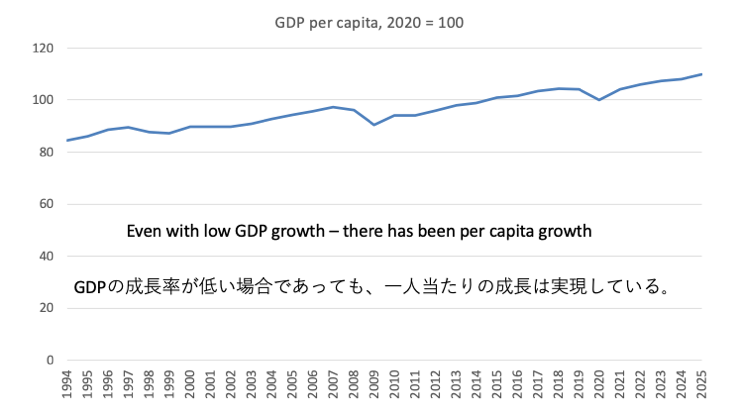
The subsequent chart reveals why.
It reveals per capita GDP since 1994.
The interval proven covers the so-called ‘misplaced a long time’ the place GDP progress has been very low and infrequently near zero.
The purpose is that even with very low GDP progress, common progress per individual has been steadily rising, which implies, on common, materials dwelling requirements can rise with low progress.
Such a graph can be unimaginable for a nation akin to Australia as a result of our inhabitants progress is far stronger than it’s in Japan.
So for nations akin to Australia, the degrowth problem might be larger.
In fact, per capita GDP is simply a median and it’s clear that distribution issues.
The rise in non-regular work has created a big phase of staff with low pay and no different entitlements which might be regular for normal staff.
On the prime finish of the distribution, issues are fairly completely different with rising affluence.
So a degrowth technique has to think about redistributing earnings from prime to backside to make it politically palatable.
The composition of output additionally issues.
A nation, for instance, may generate the above knowledge and solely produce army gear, which may hardly be mentioned so as to add to the fabric prosperity of the inhabitants.
Some coverage choices
I completed by briefly outlining a sequence of coverage choices that the Takaichi authorities ought to contemplate because it designs its fiscal enlargement.
The emphasis needs to be on redistributing staff from surplus sectors to deficit sectors, redistributing earnings from prime to backside, and investing in areas that may cut back the ecological footprint (renewables, vitality environment friendly housing, higher public transport, and so forth).
I spoke to those headings (however is not going to go into them right here):
- Enhance tax on excessive incomes and companies.
- Incentives for staff to shift sectors.
- Know-how funding.
- Enhance minimal wage – to not less than ¥1,500 per hour however ideally larger.
- Make investments closely in renewable vitality.
- Spend money on sustainable, vitality environment friendly housing.
- Promote decentralisation by bettering regional public transport.
- Promote the discount in waste (packaging and so forth).
Conclusion
This matter is one among my main analysis foci at current.
That’s sufficient for at present!
(c) Copyright 2026 William Mitchell. All Rights Reserved.
