


Equally, some currency-hedged ETFs have their very own suffixes. One instance from the identical supplier is the BMO Lengthy-Time period U.S. Treasury Bond Index ETF (Hedged Models) (ZTL.F). It gives publicity to the identical underlying bond portfolio because the unhedged model, however makes use of forex derivatives to mitigate fluctuations between the Canadian and U.S. {dollars}.
There’s a 3rd suffix price understanding about, although. And as soon as once more, we will flip to BMO for an instance: the BMO Extremely Quick-Time period Bond ETF (ZST.L). The “.L” suffix identifies accumulating models, which basically change how an ETF handles the revenue generated by its underlying investments.
Accumulating ETFs aren’t distinctive to Canada. They’re additionally extensively obtainable in Europe, the place many ETF suppliers supply accumulating share courses beneath the Undertakings for Collective Funding in Transferable Securities (UCITS) regulatory framework. That stated, these merchandise stay a comparatively small phase of the Canadian ETF market. In accordance with Cboe Canada’s ETF Market Screener, simply 93 ETFs are at present categorised as accumulating.
Given their comparatively restricted presence, it’s comprehensible that many Canadian buyers could also be unfamiliar with accumulating ETFs or how they differ from standard distributing funds. So, let’s look at how they work, the sensible variations for buyers, and, most significantly, how their mechanics have an effect on taxation.
How do accumulating ETFs work?
In Canada, one of many best methods to grasp the distinction is to match ZST.L with its distributing counterpart ZST. Each maintain a diversified portfolio of short-term, investment-grade bonds, usually focusing on maturities of 1 12 months or much less. Their goal is capital preservation and present revenue, with administration expense ratios (MERs) of 0.17% for ZST and 0.16% for ZST.L.
The principle distinction is how they deal with the revenue generated by their underlying holdings. Most standard ETFs distribute revenue to buyers periodically, whether or not month-to-month, quarterly, semi-annually, or yearly. Relying on the ETF’s holdings and construction, these distributions can encompass Canadian eligible dividends, international dividends, extraordinary revenue, realized capital good points, or return of capital.
ZST follows this standard strategy, at present providing a 2.59% annualized distribution yield. Traders obtain money month-to-month of their brokerage accounts, which they will withdraw, spend, or reinvest.
ZST.L works in another way. As a substitute of paying common money distributions, it retains and reinvests the revenue generated inside the fund. That revenue is mirrored within the ETF’s internet asset worth (NAV), permitting buyers to compound returns with out having to buy further models themselves.
Nonetheless, accumulating ETFs don’t essentially generate increased returns than their distributing counterparts. Earlier than accounting for taxes and buying and selling prices, two in any other case equivalent portfolios ought to ship roughly the identical complete return. BMO’s historic efficiency figures illustrate this.
Over the trailing five-year interval, ZST delivered an annualized complete return of three.34%, assuming each distribution was reinvested completely. ZST.L reported the identical annualized return of three.34%. The distinction is what buyers would have wanted to do to attain these outcomes.
With ZST, money would have arrived in your brokerage account each month. To duplicate the reported complete return, you’ll have wanted to reinvest these distributions by buying further models. Relying in your brokerage, that might contain inserting handbook trades, paying commissions, or leaving small quantities of money uninvested if fractional ETF purchases weren’t obtainable.
With ZST.L, the reinvestment occurs inside the ETF. You proceed holding the identical variety of models whereas the retained revenue contributes compounding to the NAV, utterly eliminating the necessity to reinvest month-to-month money funds. You’ll be able to see this distinction within the worth chart under.
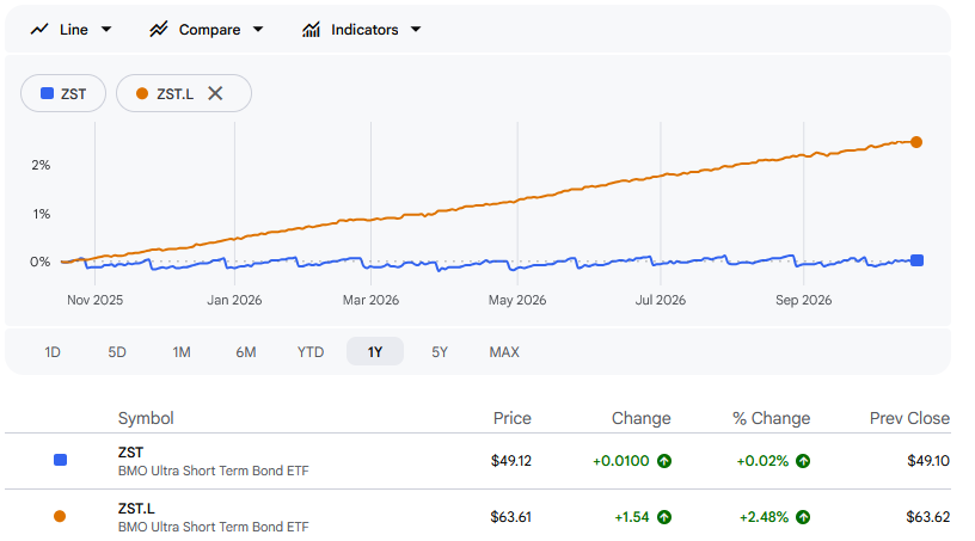
Supply: Google Finance
ZST’s market worth displays the periodic reductions related to its money distributions, so taking a look at worth appreciation alone understates its complete return. ZST.L, in contrast, retains that revenue inside the fund, permitting its NAV and, usually, its market worth to replicate the gathered returns extra immediately.
That’s the principle attraction of accumulating ETFs: they simplify the reinvestment course of whereas offering basically the identical underlying funding publicity. Nonetheless, as we’ll discover subsequent, retaining revenue inside the fund doesn’t essentially imply buyers can keep away from paying taxes on it.
You continue to must pay taxes with accumulating ETFs
A typical false impression amongst newer Canadian buyers is that accumulating ETFs supply a strategy to keep away from taxes by retaining revenue slightly than distributing it. Sadly, that’s not the way it works. The simplest strategy to perceive that is to look at the historic distributions of ZST and ZST.L. All through 2025, ZST paid a money distribution each month. Most of those distributions had been categorised as extraordinary revenue for tax functions, with smaller quantities attributable to capital good points and return of capital.

