



On this put up, we focus on insights from a latest employees report on the position of banking supervision in figuring out and disciplining failing banks. We present that financial institution failures sometimes consequence from supervisory closure selections primarily based on arduous details about e-book fairness. But arduous info is itself partly produced by supervision, as our proof means that supervisors require troubled banks to acknowledge potential losses. We argue that supervision faces a trade-off: Stricter supervision can cut back the prices of resolving failing banks, however it might probably additionally result in tighter regulatory capital constraints and maintain again credit score provide.
Function of Banking Supervision in Distressed Banks
Banking supervision seeks to safeguard the well being of the monetary system by monitoring monetary establishments and implementing regulatory compliance. Our evaluation begins with the premise that supervision has two core financial functions in dealing with distressed banks. The primary is info manufacturing. Supervisors can confirm arduous info in banks’ monetary statements, might pressure recognition of losses which may in any other case stay hidden, and produce mushy details about mortgage high quality and administration. The second function is self-discipline. As soon as supervisors determine a weak financial institution, they’ll require loss recognition, pressure recapitalization, or shut the financial institution.
In our latest employees report, we leverage supervisory information masking all industrial financial institution examinations from 2000 to 2023 to perceive the position of banking supervision in distressed banks and resolving banking crises. Within the following, we focus on a few of our key insights.
Financial institution Closures Are Supervisory Choices
The chart under exhibits the distribution of failure dates throughout weekdays for each failures within the modern banking system and from the historic, pre-federal-deposit insurance coverage period. The gold bars present that, in the previous few a long time, banks virtually all the time fail on Fridays, the Federal Deposit Insurance coverage Company’s (FDIC’s) most well-liked financial institution closure day. Of all 557 industrial financial institution failures since 2000, solely 28 banks failed on a day apart from a Friday. Moreover, when banks are closed, they’re virtually all the time bought by one other financial institution, with the acquisition sometimes being organized earlier than failure happens formally. Thus, though there are notable exceptions, trendy financial institution failures are not often triggered by market forces however as an alternative comply with a supervisory determination.
The truth that market forces equivalent to deposit withdrawals not often set off financial institution closures is in line with deposit insurance coverage and different authorities interventions affecting depositor habits and market self-discipline. This logic is properly illustrated by evaluating the timing of financial institution failures within the modern banking system with the timing of failures within the historic U.S. banking system. Utilizing information on financial institution failures between 1865 and 1935 that consists of each the pre-Federal Reserve System and pre-FDIC eras, the chart under exhibits that failure dates had been successfully uniformly distributed throughout weekdays earlier than 1935. This sample means that, earlier than federal deposit insurance coverage, financial institution house owners or depositors sometimes decided the timing of a financial institution closure. This comparability of the timing of latest and historic failures additionally highlights how supervisory actions might partly substitute for the dearth of depositor self-discipline, particularly within the presence of deposit insurance coverage.
Weekday of Financial institution Failures Pre- and Submit-FDIC
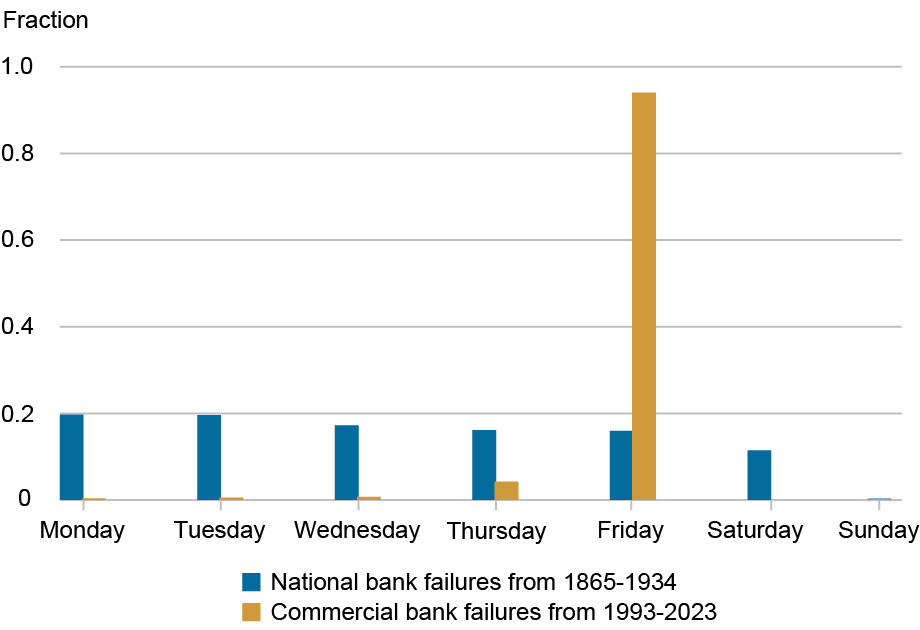
Notes: This chart plots the fraction of financial institution failures by the day of the week for each a pre-FDIC pattern consisting of failed nationwide banks from 1865 by way of 1935 and a pattern of failed FDIC member banks from 1993 by way of 2023.
Supervisors Act Primarily based on Arduous Data
When do supervisors determine to shut troubled banks? We subsequent illustrate that financial institution closures are likely to occur when banks have low reported e-book fairness and are rated at being prone to failure by supervisors. In different phrases, supervisors shut banks primarily based on arduous info on a financial institution’s e-book fairness.
For example the significance of arduous info for financial institution closures, the chart under correlates the chance {that a} financial institution fails inside the next 12 months with a financial institution’s regulatory capital ratio. We discover that the chance of financial institution failure is intently tied to a financial institution’s reported equity-to-assets ratio, with financial institution closures being virtually solely noticed for banks with very low regulatory capital. As an example, whereas banks with an equity-to-assets ratio of above 5 % successfully by no means fail, the chance of a financial institution getting closed over the next 12 months will increase quickly as capitalization falls as soon as a financial institution has an equity-to-assets ratio of lower than 5 %. If the ratio falls in need of 2 %, the chance of failure over the subsequent 12 months goes as much as virtually 70 %
Financial institution Closures, Corrective Motion, and Regulatory Capital
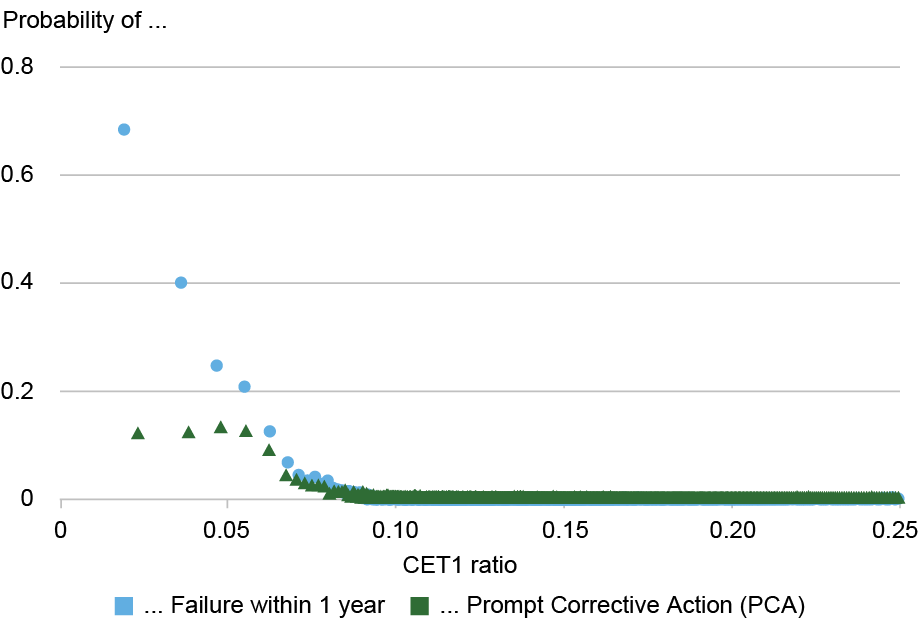
Notes: This chart exhibits a binned scatterplot of the chance {that a} financial institution fails or is topic to prompt-corrective motion (PCA) over the subsequent 12 months as a perform of the CET1 ratio. We use the pattern of all banks between 2000 and 2023 however prohibit the pattern to banks with a CET1 ratio of lower than 25% to facilitate the visualization. The CET1 ratio relies on frequent fairness tier 1 capital relative to risk-weighted property. We choose the MSE-optimal bins and every bin incorporates round 400 bank-quarter observations.
We additionally correlate Supervisory CAMELS scores with a financial institution’s fairness to property ratio. CAMELS scores assess a financial institution’s monetary well being primarily based on six standards: capital, property, administration, earnings, liquidity, and sensitivity to market danger.
The blue markers in the chart under counsel a decent relation between a financial institution’s reported e-book fairness and the supervisory composite CAMELS scores, indicating that downgrades comply with or coincide with a noticeable deterioration in a financial institution’s monetary statements. As an example, banks with an equity-to-assets ratio of above 7.5 % are sometimes rated as 1 (“Robust”) or 2 (“Passable”), with the typical ranking being round 1.8. Nevertheless, for much less well-capitalized banks, the CAMELS ranking is each greater and extra delicate to financial institution e-book fairness. Banks with an equity-to-assets ratio of lower than 4 % are virtually all the time rated with a 4 (“Poor”) or even 5 (“Critically Poor”), and the common ranking is properly above 4. This sample means that the composite CAMELS ranking intently tracks verifiable arduous info on a financial institution’s capitalization for poorly capitalized banks.
This notion that CAMELS scores for distressed banks are intently associated to arduous info is bolstered by contrasting completely different sub-components of the CAMELS ranking. The chart under additionally plots the scores for administration and capital, that are inputs into the composite CAMELS ranking. We give attention to these two sub-components as a result of, whereas the capital ranking is mechanically associated to the noticed capitalization, the administration ranking naturally permits for supervisory discretion. Whereas the composite ranking basically coincides with the typical capital ranking for low capitalization, it systematically deviates and exceeds the capital ranking for properly capitalized banks. For properly capitalized banks, the composite ranking is far nearer to the administration ranking, consistent with supervisors exercising discretion for banks that aren’t in misery.
CAMELS Scores and Regulatory Capital
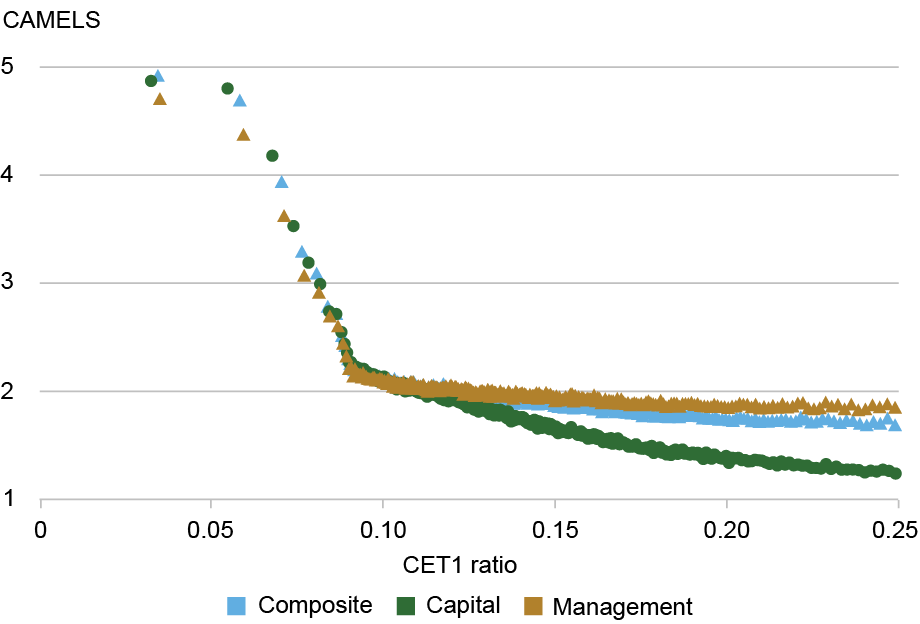
Notes: This chart exhibits a binned scatterplot of the best CAMELS ranking noticed over the subsequent 12 months towards the frequent fairness tier 1 ratio (CET1 ratio). We mix binned scatterplots for the composite ranking, the capital ranking, and the administration ranking. We use the pattern of all banks between 2000 and 2023 however prohibit the pattern to banks with a CET1 ratio of lower than 25% to facilitate the visualization. The CET1 ratio relies on frequent fairness tier 1 capital relative to risk-weighted property. We choose the MSE-optimal bins and every bin incorporates round 400 bank-quarter observations.
Supervisors Form Arduous Data
We subsequent doc that supervisors take an lively position in shaping the arduous info on financial institution capitalization obtainable in the public monetary statements of banks by way of on-site examinations, suggesting that CAMELS scores and financial institution capitalization are collectively decided in distressed banks.
We research the revisions of beforehand submitted monetary statements to know each the position of banks’ discretion of their monetary reporting and the potential position of financial institution supervision in shaping such monetary statements. The chart under plots the chance of revising a beforehand submitted name report for the six-month window round an on-site examination. We discover that the chance of revising a beforehand submitted name report will increase barely within the two months earlier than an examination after which shoots up sharply within the month of and two months proper after an examination. This sample means that the examination itself is related to a a lot greater propensity of revising authentic submission.
Revisions of Beforehand Submitted Name Reviews Round On-Website Examinations
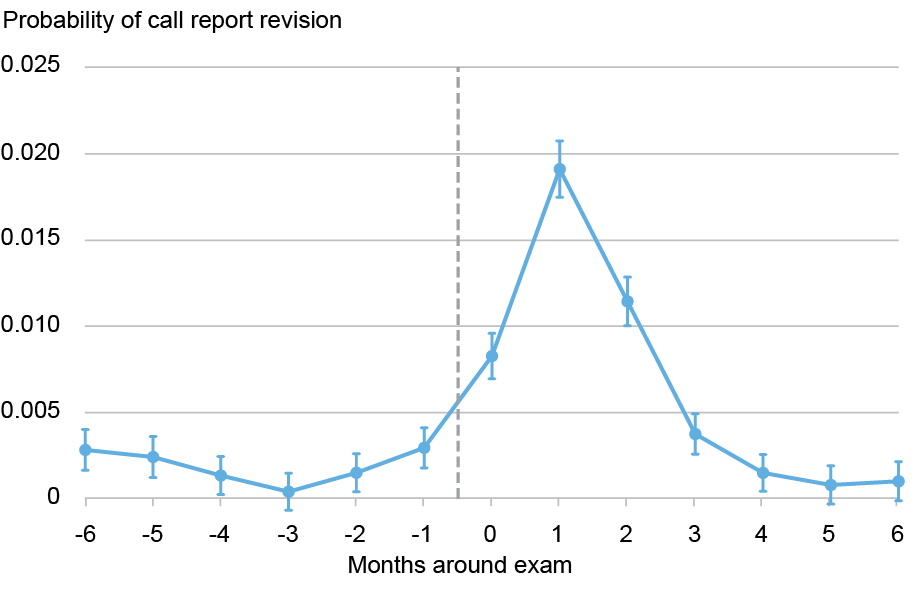
Notes: This chart presents the sequence of coefficients from an indicator for whether or not financial institution revises both its internet earnings or e-book fairness (from a Name Report submitted earlier than) on dummies that whether or not a financial institution was topic to an examination that began in month t=0. The regression additionally incorporates a set of financial institution mounted results, and a set of calendar-month mounted results. The pattern is restricted to all industrial banks and to 2007-23. Commonplace errors are clustered on the financial institution degree. Error bars symbolize 95% confidence intervals.
In our paper, we additional present that, whereas the distinction within the revisions is small after any given examination, the cumulative revisions are giant for failing banks. Within the 5 years earlier than it fails, a typical failing financial institution will expertise an 8 share level decline in its fairness‑to‑property ratio, with revisions amounting to practically 3 share factors of this decline. Thus, a substantial a part of the decline in the fairness‑to‑property ratio in failing banks happens after revisions of their authentic name report submissions.
The Commerce-Off between Strictness and Forbearance
In our paper, we additional analyze a pure experiment in the course of the 2008 World Monetary Disaster (GFC) wherein in any other case related banks had been quasi-randomly assigned strict supervisors. On this context, we outline a “stricter” supervisor as somebody who assigns a worse CAMELS ranking for the identical underlying monetary situation.
We discover that stricter supervision brought about banks to acknowledge extra losses and report decrease e-book fairness, resulting in an elevated probability of failure. Elevated strictness lowered the price of failures for the FDIC but in addition led to decreased credit score within the quick time period. Thus, our findings spotlight an essential tradeoff between strictness and forbearance. Stricter supervision can cut back the scope for playing for resurrection that will increase eventual decision prices or sustains zombie banks that misallocate credit score. Nevertheless, loss recognition and financial institution closures might come at the price of tightening credit score provide exactly when credit score circumstances are already weak. Alternatively, supervisors can interact in optimum forbearance. Forbearance might protect credit score provide and allow banks to recuperate if asset values enhance. These trade-offs are particularly salient with deposit insurance coverage, which weakens market self-discipline.
Wrapping Up
We present that the disciplining perform of supervision operates by way of each supervisory actions primarily based on arduous info in addition to the manufacturing of arduous info. Supervisory strictness in failing banks operates totally on the manufacturing of arduous info, which, in flip, determines whether or not troubled banks are closed. Nevertheless, whereas our empirical setting permits us to pinpoint the important thing trade-off between stricter supervision and decrease credit score provide, our evaluation is completely optimistic, and we don’t draw normative conclusions concerning the optimum diploma of banking supervisory strictness.

Sergio Correia is a senior economist on the Federal Reserve Financial institution of Richmond.

Stephan Luck is a monetary analysis advisor within the Federal Reserve Financial institution of New York’s Analysis and Statistics Group.
Emil Verner is the Lemelson Professor of Administration and Monetary Economics and a professor of finance at MIT Sloan Faculty of Administration.
How one can cite this put up:
Sergio Correia, Stephan Luck, and Emil Verner, “How Do Banking Supervisors Take care of Failing Banks?,” Federal Reserve Financial institution of New York Liberty Avenue Economics, November 2, 2026, https://doi.org/10.59576/lse.20261102
BibTeX: View |
Disclaimer
The views expressed on this put up are these of the writer(s) and don’t essentially mirror the place of the Federal Reserve Financial institution of New York or the Federal Reserve System. Any errors or omissions are the duty of the writer(s).

