Final Up to date on October 26, 2026
Key Takeaways
- Supporters are skipping blue hyperlinks and asking ChatGPT, Claude, Perplexity, and Google AI Overviews for solutions immediately. Rating properly in search engine outcomes isn’t sufficient to get new web site guests anymore.
- 5 fixes drive many of the outcomes: answer-led writing, Q&A web page construction, concrete numbers, schema markup, and open technical entry for AI crawlers.
Image this: a possible supporter opens Google to discover a trigger like yours. However as an alternative of clicking via a web page of search outcomes, they learn an immediate abstract generated proper on the high—and by no means go to a single web site. Search habits have essentially remodeled, and in case your content material isn’t optimized for AI-driven discovery, your group dangers turning into utterly invisible to the audiences looking for you most.
Supporters are more and more skipping the blue hyperlinks, ushered alongside by modifications to Google’s default search mode. They’re typing questions straight into ChatGPT, Claude, Perplexity, and Gemini and getting a synthesized reply in seconds, no click on required. In case your content material opens with a protracted introduction or sits behind a cluttered structure, these instruments will pull a solution from another person’s web page as an alternative.
So what’s a busy nonprofit marketer to do? Scrap the web site and rebuild from scratch? Retreat to social media? Revert to mailers? Not so quick! A handful of modifications to the way you construction content material, format pages, and open the door to AI crawlers can flip generative search into considered one of your strongest channels for getting discovered. On this article, we’ll stroll you thru learn how to optimize your web site for AI overviews. Particularly, we’ll cowl:
Desk of Contents

What’s AI overview optimization?
AI overview optimization is the method of structuring your web site content material so AI engines can pull it out and show it as a direct reply. It goes past key phrase focusing on, focusing as an alternative on crawler entry, clear Q&A formatting, and schema markup.
To maximise visibility in AI search outcomes, give attention to these basic rules:
- Lead with the reply: Put your core level within the first sentence of a bit, then observe with context. When a mannequin parses your web page, it’s checking whether or not the textual content solutions the immediate straight away. A decent 20- to 30-word abstract on the high provides bots one thing to cite, whereas the small print beneath hold human readers engaged.
- Construction round actual questions: Folks speak to AI instruments the best way they speak to an individual. Nearly no person sorts “nonprofit grant eligibility standards” into ChatGPT; they ask one thing like “How does a group group qualify for federal grants?” Write your H2s and H3s as these precise questions so crawlers can match your content material to what individuals are asking.
- Open the technical doorways: Heavy JavaScript wrappers, difficult structure tables, or a blocked crawler directive will deter AI bots earlier than they ever see your details. Pairing FAQ schema and clear HTML on the backend provides crawlers a transparent path to your information.
Conventional search engines like google and yahoo constructed rankings largely on backlinks and optimized content material. Generative engines lean extra on how constant your details are throughout a number of sources. Due to this fact, websites with out structured information are inclined to get cited far much less usually. Begin by auditing your highest-traffic useful resource. Swap obscure headers for actual questions and add a abstract sentence to the highest of every main part. These modifications take lower than an hour and might help instantly enhance your odds of displaying up in a generative search snippet.
Generative engine optimization (GEO) vs. reply engine optimization (AEO)
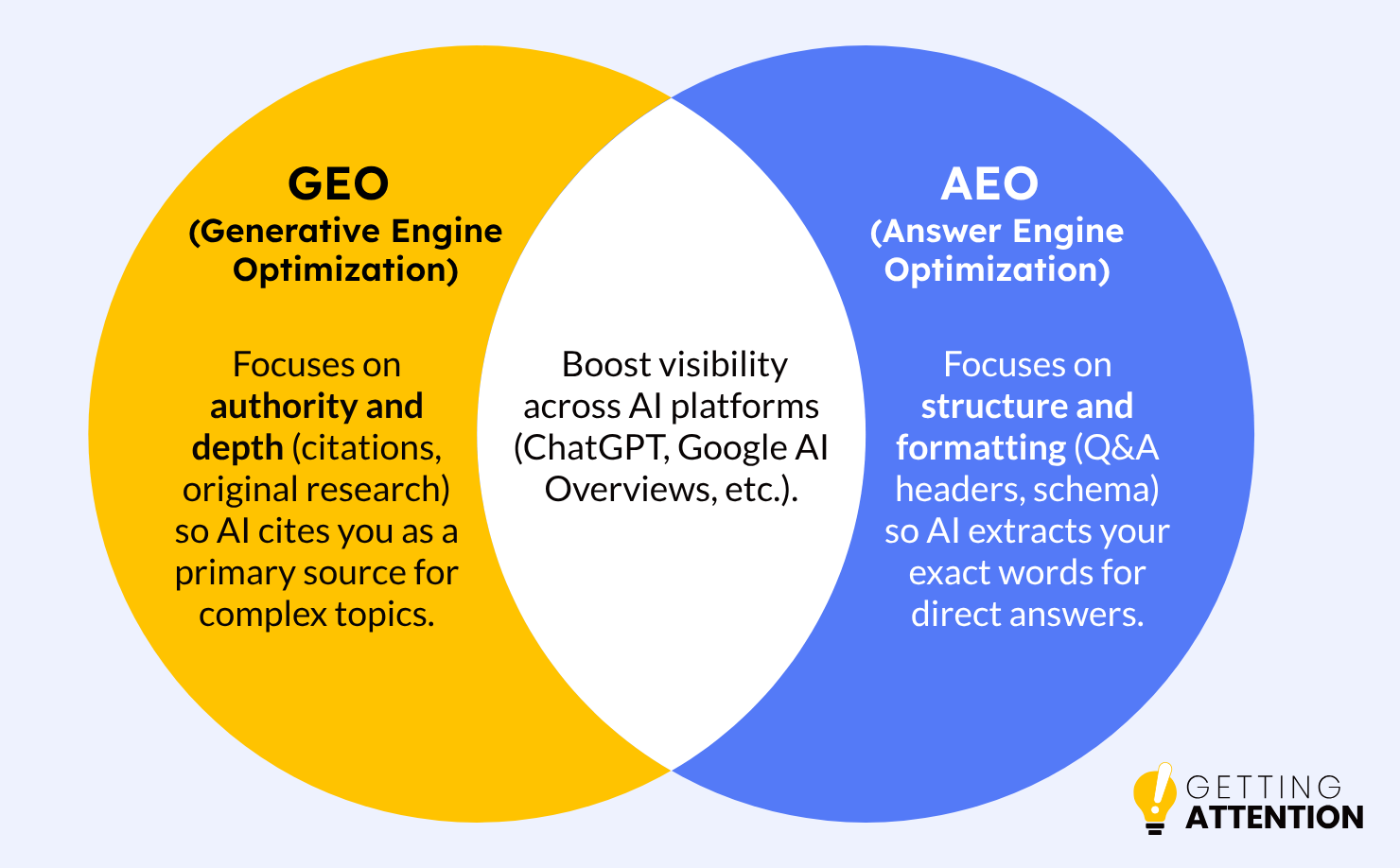
You’ll have heard just a few completely different acronyms getting thrown round to explain the method of optimizing net content material for AI. The core distinction between AEO and GEO is that GEO focuses on constructing area authority so AI fashions can synthesize your content material into broad search outcomes, whereas AEO focuses on formatting textual content so fashions can extract direct, word-for-word solutions for particular questions. Each methods assist drive visibility throughout instruments like ChatGPT, Claude, Perplexity, and Google AI Overviews by addressing completely different elements of how generative search engines like google and yahoo course of net content material:
- Generative Engine Optimization (GEO): GEO is targeted on turning into a main supply that AI fashions depend on when synthesizing complicated matters. It depends closely on off-page authority and total content material depth, together with verified statistics, unique analysis, third-party citations, and constant model mentions throughout trusted domains. Generative engines consider these belief indicators to find out which websites to quote as reference hyperlinks when constructing complete AI Overviews.
- Reply Engine Optimization (AEO): AEO focuses on construction and extractability so search bots can elevate direct solutions straight out of your web page. This includes utilizing clear Q&A header tags, concise opening abstract sentences, structured tables, bulleted lists, and JSON-LD schema markup (equivalent to FAQ and Group schema). Content material that immediately matches pure person speech patterns makes it straightforward for reply engines to show or learn your textual content verbatim.
In keeping with a 2026 research by Seer Interactive, your Generative Engine Optimization (GEO) efforts ought to instantly prioritize comparability and question-format pages, as these set off AI Overviews 95.4% and 85.9% of the time, respectively. Balancing each GEO and AEO methods creates a complete strategy to AI visibility whereas sustaining your content material’s authority.
The best way to optimize for AI Overviews
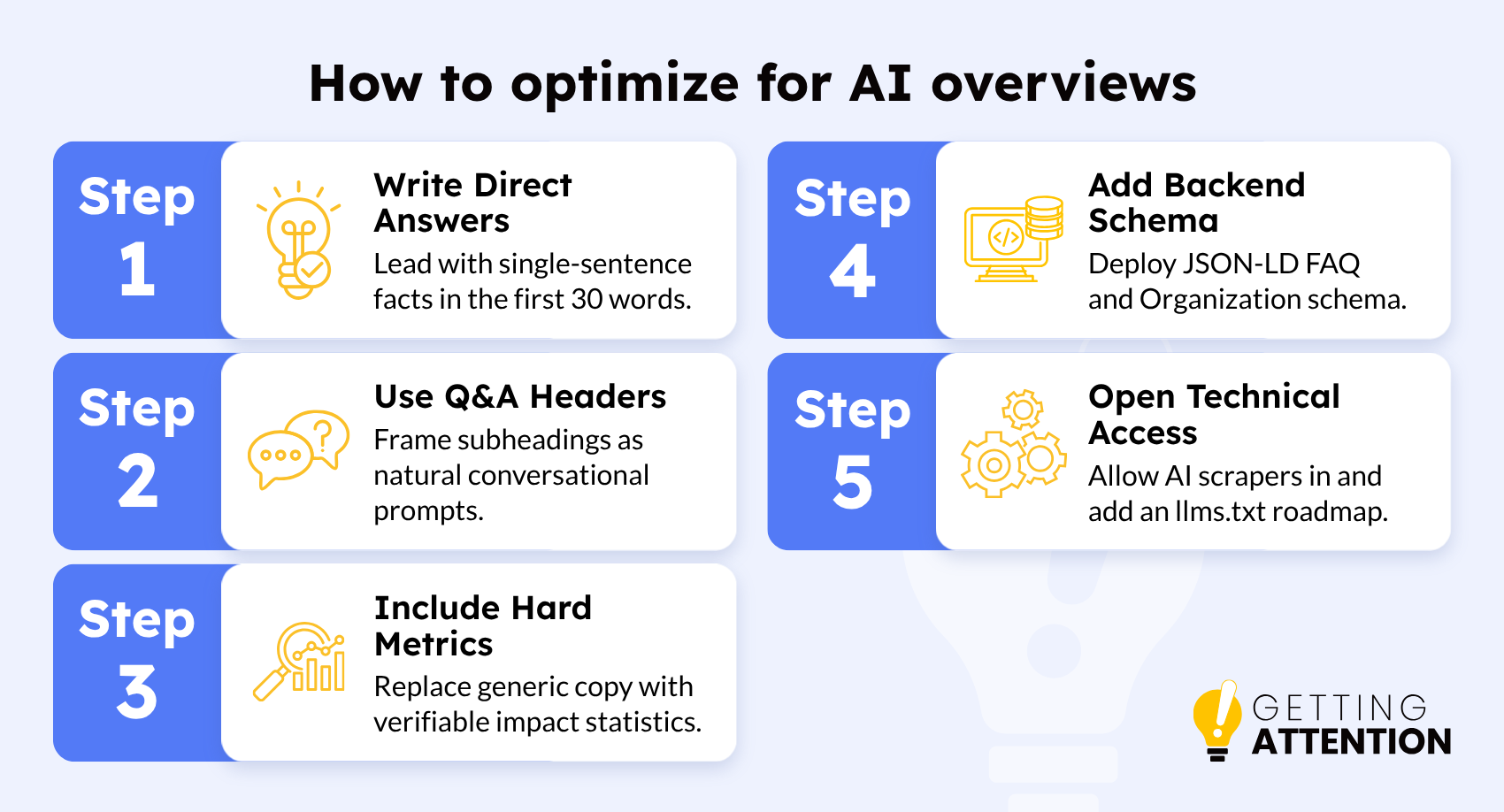
As search habits shift towards AI-generated solutions, staying discoverable means adapting your web site construction and content material for these new instruments. Making just a few focused updates ensures your nonprofit stays a go-to useful resource for potential supporters. Listed below are 5 sensible steps you’ll be able to take this week to make your web site simpler for AI instruments to search out, belief, and quote:
1. Write in direct, answer-led sentences
AI engines don’t learn for pleasure. They scan for a transparent, quotable reality, so give them one straight away. Apply these writing practices to make sure AI engines rapidly discover and cite your content material:
- Lead with the reply: Open every web page or part with one direct sentence that solutions the plain query, then add context after. State your program’s final result or definition first, and save the backstory for the paragraphs that observe. That retains the very fact straightforward for AI readers to elevate whereas nonetheless giving human readers a motive to maintain going.
- Entrance-load the abstract: Put your most important level within the first 25 to 30 phrases after a heading. Language fashions weigh textual content close to the highest of a bit extra closely, so a good opening line lowers the work a crawler has to do and improves your odds of getting cited.
- Write declaratively: Skip hedging phrases like “our program is commonly thought-about to be useful.” Say what’s true: “Our youth program offers after-school tutoring to 500 college students yearly.” Particular, lively statements learn as extra reliable to folks and parsers alike.
2. Construction content material with clear Q&A formatting
Pages formatted like a dialog usually tend to be pulled into AI solutions than pages formatted like an essay. Comply with these structural methods to align your pages with conversational search queries:
- Map headings to actual questions: Base your H2s and H3s on the precise questions your viewers asks, and reply each in a brief paragraph or bulleted listing proper under it. A devoted FAQ web page is the quickest approach to do that at scale. Pairing this with stable, high quality web site content material enables you to reply donor and volunteer questions in a single useful resource that’s straightforward for a crawler to index.
- Match person language: Write subheads the best way your supporters truly speak, not the best way your inner crew talks. If somebody’s asking “How a lot of my donation goes to administration?”, use that precise phrasing as your H2 as an alternative of one thing like “Monetary Stewardship Overview.”
- Group FAQs into their very own block: Put 5 – 6 associated questions collectively close to the underside of key pages. That remoted cluster is simpler for a crawler to digest than the identical info scattered via paragraphs, and it tends to spice up the web page’s total authority.
3. Be particular and concrete
Generic copy that would belong to any nonprofit doesn’t give an AI mannequin something price citing. Use these methods to make your content material distinct, authoritative, and extremely citable:
- Use actual numbers: Floor your content material in your individual applications and information. “We helped many households this yr” is obscure. “We offered 14,250 meals to households in 2026” provides AI fashions one thing concrete to reference the following time somebody asks about starvation reduction in your space.
- Publish unique information: Case research, survey outcomes, and inner metrics that don’t exist anyplace else make your web site price citing. AI instruments favor sources with main analysis, because it’s the one factor they will’t pull from different web sites.
- Hyperlink to credible outdoors sources: Level to analysis, authorities information, or established research once they again up your claims. That indicators to crawlers that your content material is well-researched, which will increase the authority your area carries throughout generative analysis.
4. Translate your web site for bots with schema markup
AI crawlers learn code sooner than they learn prose. Schema markup tells them precisely what your web page means. Implement these structured information practices to make clear your web page content material for search bots:
- Add structured schema: Create Group schema in your homepage, Service or Occasion schema on transactional pages, and FAQ schema in your weblog posts so bots can parse and show your info appropriately. Pairing this with technical website positioning assist catches errors earlier than they trigger a crawler to misinterpret your group’s particulars.
- Use JSON-LD: Place JSON-LD scripts in your web page headers to spell out how your content material items relate to one another. It’s the format trendy search engines like google and yahoo favor, and it will get learn earlier than your visible structure even hundreds.
- Verify your markup usually: Run your schema via Search Console or one other schema validator each quarter. One lacking bracket or comma can break the entire block, making it invisible to a crawler.
5. Open your technical doorways to AI crawlers
Not one of the above methods matter in case your backend settings are blocking the bots making an attempt to learn your web site. Take these technical steps to make sure crawlers can seamlessly learn your web site:
- Verify your robots.txt file for outdated disallow guidelines, particularly after a web site redesign. It’s widespread to briefly block websites for one motive or one other, however one leftover directive can cover your entire useful resource library from search and AI crawlers alike.
- Hold your HTML clear. Skip pointless nesting and heavy visible plugins. A crawler ought to have the ability to scan your textual content in milliseconds.
- Add an llms.txt file to your root listing. A plain-text, markdown-formatted map of your key pages and details constructed particularly for AI fashions cuts down on hallucinated particulars about your group.
- Verify your user-agent permissions to substantiate crawlers like GPTBot and ClaudeBot are allowed in. A firewall or internet hosting setup that blocks them by default retains you out of generative search outcomes fully, even when every part else in your web site is optimized.
- Enhance web page pace and Core Net Vitals. Crawlers work on a time finances, and a sluggish web page can outing earlier than a bot finishes studying it, making it much less prone to cite you.
By persistently making use of these optimizations, you rework your web site from a passive useful resource right into a dynamic asset that search engines like google and yahoo can simply parse. As generative search continues to evolve, these foundational habits will guarantee your nonprofit stays a trusted, main supply on your supporters.
Maximize your visibility with AI search optimization for nonprofits
Getting Consideration gives a devoted AI optimization service assist for nonprofits, constructed to work alongside our current Google Advert Grants and web site optimization providers. The aim is similar as every part else we do: assist your group attain the folks almost certainly to assist it.
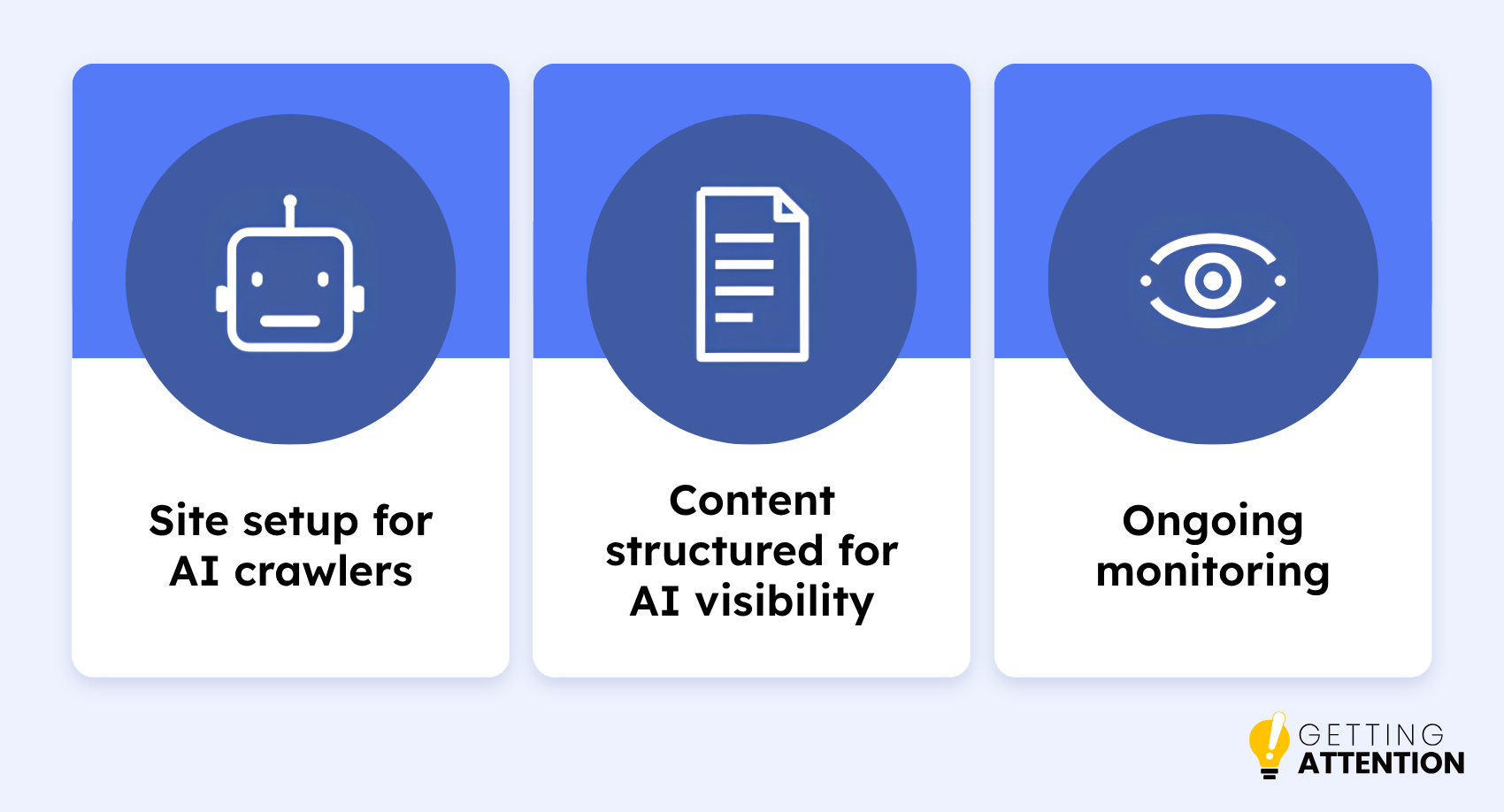
Right here’s what working with us appears to be like like:
- Web site setup for AI crawlers: We be sure that AI instruments and bots can entry and skim your web site the best way they’re alleged to, utilizing fundamental groundwork like an llms.txt file. It’s a fast, low-risk addition now, and it might matter extra later if AI instruments begin counting on it extra closely.
- Content material structured for AI visibility: We write and construction your content material with clear schema, correct headings, clear Q&A formatting, and concise summaries that AI instruments can simply pull from when answering somebody’s query. This fashion, your content material can get picked up when customers ask AI instruments queries associated to your nonprofit.
- Ongoing monitoring: We control your group’s schema and readability in Google Search Console, and flag when one thing appears to be like off or old-fashioned. That approach, we will fold a repair into your ongoing content material work.
Incessantly requested questions on AI overviews
How do I make my nonprofit seen to ChatGPT and AI overviews?
You want each technical crawler entry and answer-led copywriting throughout your web site. Audit your high program pages and rewrite their openings in order that they reply widespread questions throughout the first 30 phrases. Add JSON-LD schema, particularly FAQ and Group schema, to your most important templates. Then examine your server directives to substantiate crawlers like GPTBot can truly attain your public useful resource pages.
What’s the distinction between GEO and AEO?
GEO builds your total model authority via citations, belief, and a monitor file that will get your area used as a supply when a mannequin generates a solution. AEO is about format; particularly, bulleted lists, Q&A headers, and definition blocks structured so an algorithm can pull your copy straight into a solution field. Briefly, GEO makes you reliable, and AEO makes you extractable.
How does schema markup assist AI discover my web site?
A schema is backend code that tells search algorithms precisely what your content material means. Human guests see your design and structure; crawlers learn uncooked HTML. Wrapping your textual content in JSON-LD tags clarifies what your group does, what occasions you host, and the way your FAQ solutions relate to what folks seek for, so there’s no ambiguity throughout indexing.
What’s an llms.txt file, and do nonprofits want one?
An llms.txt file is a plain-text doc in your web site’s root listing that provides AI fashions a fast, token-efficient map of your most necessary pages. The place a sitemap.xml is uncooked XML constructed for crawlers, an llms.txt highlights your core details and key URLs in clear markdown. It’s a low-lift solution to level generative instruments towards verified info as an alternative of letting them guess.
Will AI search change my Google Advert Grant site visitors?
No. Search adverts and AI reply packing containers serve completely different moments within the supporter journey. Paid search nonetheless wins for high-intent, transactional searches, like looking for “meals financial institution donation websites” or “volunteer alternatives”. Generative engines are higher suited to broad, informational questions. AGoogle Advert Grants account captures the folks able to act proper now, whereas Meta adverts can prolong that very same structured strategy to social apps. Operating each means you keep seen whether or not somebody’s researching or able to act.
Wrapping up
Optimizing for AI search is an ongoing course of, not a one-time challenge, with a payoff that grows as extra folks search this manner. Begin small this week: replace your FAQ web page with direct solutions and validate your schema.
The advantages compound from there. Optimizing your group’s net presence for generative search retains paying off as conversational search adoption grows. The earlier you begin, the earlier your nonprofit is the reply AI instruments attain for.
Further Sources
Discover these complete guides to strengthen your total digital and advertising and marketing technique: