

Neoliberalism has scammed everybody. It advised residents that if we had been liberated from authorities laws and authorities management of enterprises that delivered important companies then we might attain the absolute best outcomes that had been out there. A barrage of messaging from media firms blatantly serving the pursuits of capital and assume tanks masquerading as unbiased analysis organisations however that are in actuality simply propaganda machines for his or her funding sources strengthened the narrative that freedom lay in lowering the federal government footprint on our lives. That was all a ruse. In his 2005 e-book – A Temporary Historical past of Neoliberalism – David Harvey referred to using “obscure rhetorical gadgets” that labored on our instinct. In fact, cognitive linguists and associated scientists repeatedly inform us that our instinct recurrently leads us astray. The ‘freedom’ narrative hid the actual agenda, which was to overturn the progressive advances achieved in the course of the full employment interval following WW2. Neoliberalism was about restoring the dominance of capital and creating mechanisms to retrench the advances that had lowered inequality and improved prosperity for staff. In Japan, the identical forces had been unleashed by the context was considerably totally different to the West, significantly the English-speaking world. That is Half 2 of my temporary enquiry into the neoliberal ideology has interacted with the standard cultural options of contemporary Japan.
In – The intersection of neoliberalism and conventional Japanese values – Half 1 (October 22, 2026) – I laid out the small print of Heizō Takenaka’s neoliberal insurance policies between 2001 and 2006.
The neoliberal ideology (and praxis) that Takenaka was selling and introducing into Japan was completely in keeping with the Western model, which was a universalist dogma.
This one-size-fits-all strategy got here with no historic, cultural, ethnic, or different nation particular traits.
It was about utilizing nationwide sources to additional the pursuits of worldwide capital.
Nonetheless, in international locations the place there have been robust conservative components centred on the nationwide tradition and traditions, such a globalist imaginative and prescient offered issues.
Japan was a theatre for such a stress within the Nineteen Eighties.
And the groundwork for Takenaka’s ministerial interventions had been laid in that interval.
However we are able to return a lot additional to the latter years of the Meiji interval which ran from October 23, 1868 to July 30, 1912.
The Meiji Restoration (1868) was extremely vital in Japanese historical past as a result of it ended 250 years of feudal guidelines beneath the Tokugawa shogunate and restored the authority of the Emperor.
It led to a collection of reforms in authorities and society, together with the introduction of common obligatory schooling.
It additionally took on many Western features together with acceptance of Western science, technological buildings, mass communications (publish, phone), a nationwide railway and a restructuring and modernisation of the army (the latter which elevated the bellicosity of Japanese army leaders and led to the First Sino-Japanese Struggle (1894-1895) and the Russo-Japanese Struggle (1904-1905)).
The Japanese schooling system additionally adopted a lot of the curricula from European international locations and the US within the early Meiji years.
Nonetheless, this created tensions as a result of critics claims there was too larger emphasis on mental pursuits on the expense of engendering the “disciplinary worth of ethics” (Supply).
In 1879, in response to this stress, the Emperor decreed that “ethical schooling and sensible studying constituted the basics of schooling”.
The Confucian ideas had been bundled up into ethics textbooks and by 1890, the Japanese schooling system formally launched – 修身 (Shūshin) or “Oral Instruction on Morality” as a obligatory topic in faculties.
The state noticed this as a means of turning the previous feudal topics into loyal and obedient civic-minded residents.
Within the Nineteen Thirties, the courses in 道徳 (Doutoku) or morality or advantage turned emeshed in Japanese militarism and strengthened the burgeoning nationalism emphasising that responsibility of people to obey the Emperor irrespective.
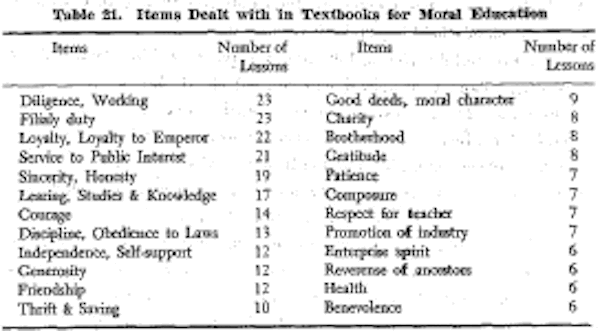
The next desk taken from the Japanese authorities White Paper – Japan’s Progress and Schooling 1963 – exhibits the subjects that had been taught in these new obligatory topics.
One of many central ideas, which bears afterward how neoliberalism permeated Japanese society, was a refinement of the outdated idea of – 迷惑 (Meiwaku).
The idea traditionally (that’s, earlier than the Meiji period) had Buddhist beginnings and described the constraints confronted by a person searching for enlightenment (Supply).
Because the inhabitants expanded and cities turned extra crowded, the idea advanced (in the course of the Edo interval) into an unwritten rule to not trigger issues for different individuals – that’s, behaving in public and following practices of etiquette.
Nonetheless, this launched a brand new drawback.
With the arrival of the Meiji interval and its adoption of many Western practices, the cultural understandings that accompany these practices in say England had been absent in Japan.
One commentator stated there was a failure to know the idea of a ‘British gentleman’ and the way one ought to act inside these esentially Western establishments that the foundations had imported into Japan.
Because of this, the outdated Confucian idea morphed into 迷惑 (Meiwaku) and college students had been launched to subjects (as above) – “British manners and compliance” not by studying the methods of the foreigners however relatively by way of the applying of an outdated custom meiwaku.
College students had been now taught that to be a correct citizen in Imperial Japan they needed to ‘迷惑をかけない’ (meiwaku wo kakenai) or not trigger hassle for others.
Importantly, on this new period of speedy urbanisation and public transit methods, the idea generalised from worrying in regards to the affect in your neighbours to one the place a person ought to at all times be on the look out and keep away from any motion which may hassle anybody else in public (Supply).
What has this to do with the introduction of neoliberalism into Japanese society?
You will need to perceive the idea of a person in Japan.
It’s fairly totally different to the notion that we’ve within the West.
And Meiwaku is on the centre of this distinction.
For us, individualism is about our perceived proper to not be infringed upon by society.
We develop up being taught that our freedom of area, selection and speech are rights which might be innate and persist so long as we don’t infringe on the rights of others.
Freedom is about asserting these pure rights – it’s all about ‘us’ and ‘me’ and ‘I’.
In Japan, through the idea of Meiwaku, the person is embedded in a shared social concext and relatively than being a proper, freedom pertains to our obligation to not trigger issues for others, wherever they could be.
Within the West, we litigate to protect our sense of freedom – in different phrases, interventions come after an issue happens.
In Japan, all efforts are made to not create the issue within the first place, which is among the foundational ideas of particular person behaviour in Japanese society.
Western individualism usually entails ex publish, retrospective motion (litigation), whereas Japanese individualism is ahead pondering.
As an apart this is among the difficulties in studying the Japanese language.
There are such a lot of totally different phrases for a similar factor and the selection relies on the context and the purpose is to speak with out inflicting any drawback, inconvenience or offence.
In Japan, this has created a tradition of 自己責任 (jiko sekinin or self-reliance or self accountability), which has turn into the bridge that allowed neoliberal ideology to permeate Japanese society.
A relatively pointed instance of jiko sekinin was occurred in two incidents in 2004.
The primary was the Iraq hostage scenario in April 2004 the place three Japanese photojournalists had been held in Iraq by a militant group.
The second incident was the – Killing of Shosei Koda – “a Japanese citizen who was kidnapped whereas touring Iraq and later beheaded in October 2004”.
In each instances, the hostages had been extremely criticised and publicly shamed within the Japanese media and by politicians in Japan for inflicting hassle by placing themselves in danger.
Neoliberalism exploited the standard idea of meiwaku and its relationship to ‘jiko sekinin’.
The ideologues claimed that societal issues had been finally the results of particular person behaviour not conforming to meiwaku and refusing to take accountability.
In different phrases, the idea of systemic or institutional failure is expunged from the notion of individuals.
And, in a means that’s similar to how issues occur within the West, all types of drawback – homelessness, low-wage precarity, poverty, and so on are blamed on the person relatively than the society.
These dilemma require the person interact in self reliance and take care of the issues they’ve discovered themselves burdened with.
Blame the sufferer is an idea we are able to simply relate to on this neoliberal interval.
In Japan, nonetheless, the nuance is that the ethical schooling enforces the notion inside the person who they’re accountable and mustn’t search for help from others.
In different phrases, meiwaku is about coping with your individual issues and never anticipate assist from others or the state.
And the stress of adopting this way of living could be seen as inflicting a myriad of social dysfunctions – overwork, refusal to take holidays or ask for depart to take care of household issues, or accessing social welfare nets, and for an growing variety of Japanese it additionally means coming into 引きこもり or = Hikikomori = the place “reclusive adolescents or adults … withdraw from social life, usually searching for excessive levels of isolation and confinement.”
Whereas clearly neoliberalism within the West and in Japan shares many traits, it’s the means that the neoliberal ideology works alongside meiwaku that creates the distinctive Japanese model of neoliberalism.
Conclusion
In Half 3, I’ll discuss in regards to the conventional idea of しょうがない (Shōganai) or 仕方がない (shikata ga nai) which interprets into ‘there may be nothing that may be performed about it or it may’t be helped’.
Popping out of Buddhist traditions, this idea is a means that people can take care of stress and crises.
An individual will merely acknowledge that the scenario is past their management and undertake a peaceful acquiescence and get on with their lives.
Within the unique context, it was a means of coping with adversity and holding one’s cool and charm.
Nonetheless, within the neoliberal period it has been weaponised to elicit consent and acceptance of the vicissitudes that the modifications to the state (welfare retrenchment, labour market deregulation and so on) have wrought on the residents.
As financial inequality will increase and dealing turns into extra precarious and low-paid, the shōganai tradition results in individuals accepting the growing hardships and erasure of their prosperity.
It doesn’t imply they prefer it however it does imply that society doesn’t break down as a consequence.
Precarious work is constructed as a pure financial actuality relatively than the results of specific authorities legislative modifications that broke the everlasting job for all times mannequin.
One in all my associates right here says that persons are conditioned to react to their declining fortunes and the enrichment of the elites by respiratory out and saying ‘shōganai’
This idea interacts with the concept of depoliticisation that we outlined in our e-book – Reclaiming the State: A Progressive Imaginative and prescient of Sovereignty for a Submit-Neoliberal World (Pluto Books, September 2017).
That’s sufficient for right this moment!
(c) Copyright 2026 William Mitchell. All Rights Reserved.

