



The AI growth is displaying up in several corners of the U.S. financial system, together with worldwide commerce. Imports of semiconductors, servers, and computing tools have climbed sharply but the U.S. present account deficit has been largely unchanged. To higher perceive how the AI growth has not considerably affected the commerce stability, think about that the present account is dictated by the hole between home saving and funding spending. It seems that mixture saving and funding spending haven’t modified a lot through the AI growth. Combination funding has not risen as a result of weak spot exterior the AI sector and enterprise saving has remained sturdy.
Gross Flows versus Internet Positions
Current work has proven that AI-related imports accounted for a nontrivial share of U.S. imports up to now few years. In actual fact, it reached a excessive of 23 p.c in 2025. Nonetheless, a rustic can import quite a lot of capital tools or entice quite a lot of international capital with out essentially operating a bigger exterior deficit, offered it saves sufficient to pay for the funding spending itself. This concept may be formalized by noting that the present account is a web idea, the place the stability equals a rustic’s gross saving much less its gross home funding. A latest Liberty Road Economics submit gives an in-depth clarification linking the commerce stability to the financial savings and funding stability through nationwide accounting.
For the AI growth to widen the deficit, it should increase funding with out a matching rise in saving. Two channels can depress personal saving: a wealth impact, the place fairness good points elevate family consumption, or a fall in enterprise saving. Each had been at work through the dot-com period, when the two channels moved collectively.
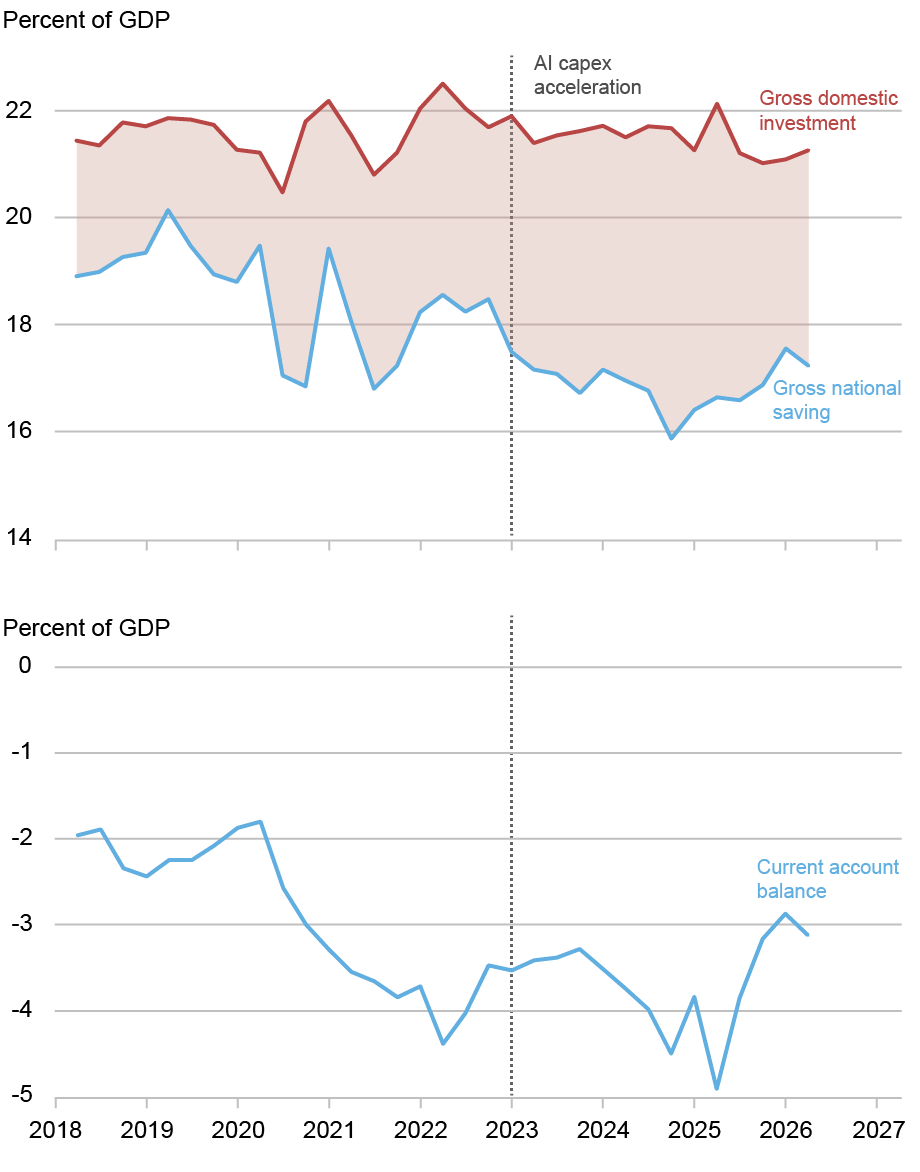
The highest panel of chart beneath plots the savings-to-GDP and funding spending-to-GDP ratios since 2018, whereas the underside panel plots the present account-to-GDP ratio. The present account deficit widened over this era, from roughly 2.2 p.c of GDP on common in 2015–19 to about 3.7 p.c since 2023. Discover, nonetheless, that the widening comes virtually solely from the saving facet. Funding as a share of GDP has been remarkably regular, particularly since 2023 when the AI capex buildout began in earnest.
Saving, Funding, and the Present Account
Funding Has Been Reallocated, Not Expanded
Gross home funding averaged 21.3 p.c of GDP within the 5 years earlier than the pandemic. Over 2023–2026:Q1 (the interval spanning the AI capex acceleration), it averaged 21.5 p.c, and over the previous 4 quarters, 21.1 p.c. The AI growth is thus not seen within the mixture funding price in any respect.
To higher perceive why the AI growth has not had a tangible affect on mixture funding, it’s helpful to have a look at how funding has various throughout sectors of the U.S. financial system. Because the chart beneath reveals, the AI contribution to nonresidential funding has not been small and has been rising lately, however it has coincided with weak spot in different sectors of the financial system. For instance, the surge in manufacturing unit building that adopted the 2022 industrial coverage laws has pale, and funding in buildings and tools exterior the expertise advanced has been smooth. Information facilities and information-processing tools have helped take up the slack, however to not such an extent as to lift mixture funding relative to nationwide financial savings. Additional, residential funding has been declining lately.
Composition of Nonresidential Funding
Consumption Has Additionally Not Adjusted
It’s attention-grabbing to distinction how financial savings have adjusted through the AI growth up to now relative to the dot-com period, which is usually highlighted as a interval of elevated fairness values. Through the dot-com enlargement, personal saving fell by practically 3 share factors of GDP between 1995 and 2000 as households spent out of rising fairness wealth. Nothing comparable is occurring at present. Personal saving has averaged 20.8 p.c of GDP since 2023, down from 21.3 p.c earlier than the pandemic—a distinction of half a share level, and one that may be attributed as a lot to the post-pandemic unwinding of accrued financial savings as to something AI-related.
Enterprise Sector Saving Has Not Fallen
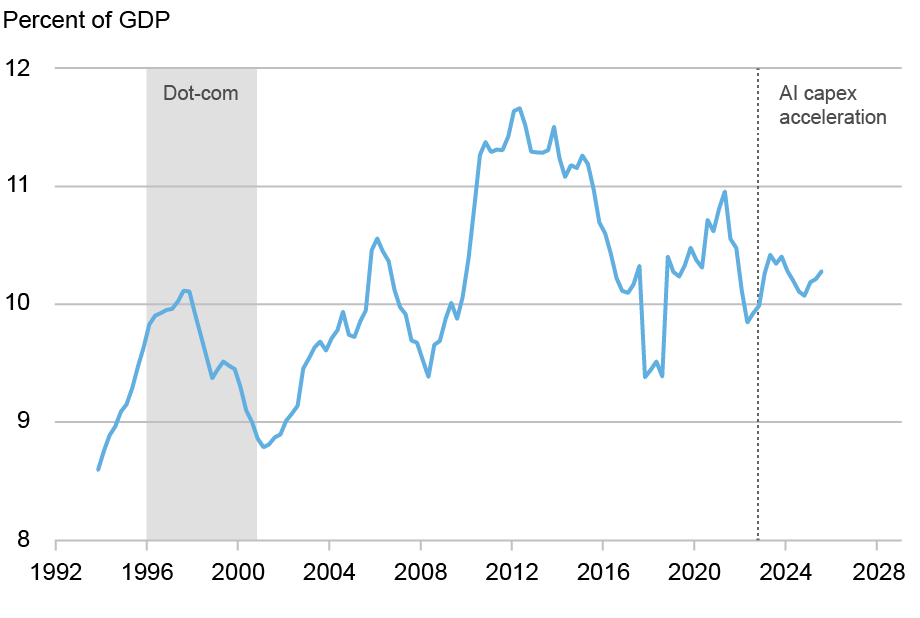
Let’s flip to enterprise saving, outlined as income minus bills excluding funding spending. The salient distinction between the dot-com and AI episodes isn’t the dimensions of the funding however the money place of the companies doing it. The dot-com buildout was concentrated in younger telecom and tools producers with skinny or unfavorable working money move; as earnings compressed late within the growth whereas dividends remained sticky, retained earnings and with them enterprise gross saving fell. Enterprise saving was thus a drag on personal saving at exactly the second funding was peaking. The AI buildout, against this, is concentrated in probably the most cash-generative companies within the financial system, and enterprise saving has up to now held up by way of the capex surge fairly than eroding in opposition to it.
The chart beneath illustrates these factors by plotting the enterprise sector’s financial savings price over time. Enterprise saving has averaged 10.9 p.c of GDP over the previous 4 quarters, in keeping with the roughly 10.5 p.c averaged earlier than the pandemic, and above the dot-com trough of roughly 8.8 p.c of GDP in late 2000/early 2001.
Enterprise Sector Saving
Authorities Saving Has Moved within the Reverse Course
Authorities saving affords the sharpest distinction between the 2 episodes, and it runs in the other way from personal saving. Through the dot-com enlargement, authorities saving rose by practically 5 share factors of GDP, swinging from a deficit of about 1 p.c of GDP in 1995 to a surplus of roughly 4 p.c in 2000 as capital-gains-driven tax receipts flooded federal coffers. That fiscal windfall offset a lot of the pickup in personal dissaving, which is one purpose the present account deficit widened by “solely” 2.5 share factors whilst households drew down saving so aggressively.
At this time the fiscal place is doing the alternative work. Authorities saving has fallen from about –2.2 p.c of GDP in 2015–19 to about –4.0 p.c since 2023, a deterioration of roughly 1.75 share factors.
Decomposing the Contributions to the Present Account Steadiness
Placing the above items collectively, the exterior stability may be decomposed into its three sources relative to a pre-pandemic baseline (that’s, relative to 2019:This autumn). Of the roughly 2.4 share level widening within the saving–funding hole, authorities dissaving accounts for about 1.75 share factors, decrease personal saving for about half some extent, and better funding for basically nothing. Due to this fact, adjustments in fiscal coverage have been the key driver of present account dynamics, with a smaller function performed by personal saving, and no discernible funding channel.
Caveat and Why Issues May Change
There is a vital caveat to notice earlier than drawing conclusions on the AI’s affect on the present account going ahead. The introduced capital spending plans of the key expertise companies for 2026 and 2027 are significantly bigger than what has already been constructed, whereas the offsetting weak spot in residential and nontechnology funding won’t persist indefinitely. So, whereas the AI growth has not but been massive sufficient relative to the remainder of the financial system to maneuver the U.S. exterior stability, if the present drags on different funding fade as AI capex accelerates, each the upper funding spending and fewer enterprise saving will work to extend the present account deficit.

Julian di Giovanni is an financial analysis advisor within the Federal Reserve Financial institution of New York’s Analysis and Statistics Group.
How you can cite this submit:
Julian di Giovanni, “Has the AI Growth Impacted the U.S. Present Account?,” Federal Reserve Financial institution of New York Liberty Road Economics, October 14, 2026, https://doi.org/10.59576/lse.20261014
BibTeX: View |
Disclaimer
The views expressed on this submit are these of the writer(s) and don’t essentially replicate the place of the Federal Reserve Financial institution of New York or the Federal Reserve System. Any errors or omissions are the duty of the writer(s).

